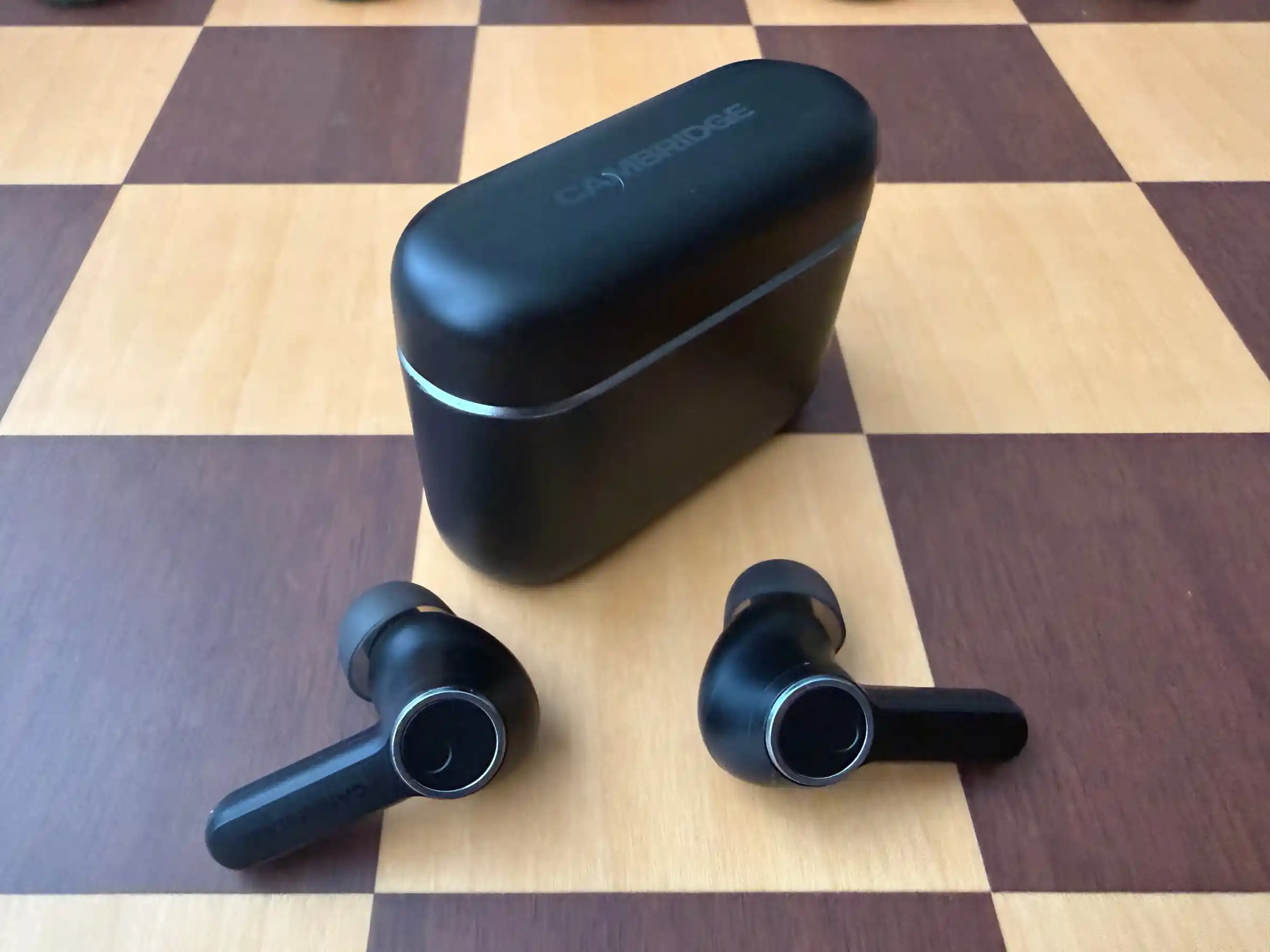
Why revisit it now
The Melomania A100 launched in June 2025 at £119 / €139. It reached the US later that year at $149.99. It now often drops to about $99, or £79 in the UK.
Cambridge has just announced the A100SE. It adds Dolby Audio processing and a blue finish.
Of the 11 pairs I've lived with, the A100 is in my top league for sound. In my QCC3091 comparison, I called it the one I'd keep. This post explains why.
The main reason is the stage. Most earbuds paint music as a flat picture inside your head. The A100 puts you in front of a scene. On this point, almost every reviewer agrees with me.
These aren't week-one impressions. I've used it daily since early 2026.
What's inside
From research Cambridge is open about the amplifier and the chip. It says less about the driver.
| Spec | Cambridge Audio Melomania A100 |
|---|---|
| Driver | 10 mm dynamic, neodymium magnet |
| Amplifier | Class A/B |
| Chip | Qualcomm QCC3091 |
| Bluetooth | 5.4, multipoint |
| Codecs | SBC, AAC, aptX Adaptive, aptX Lossless, LDAC |
| Weight per bud | 4.7 g |
| Battery (rated) | 6.5 h ANC on, 11 h ANC off, 39 h with case |
| Microphones | 6 (3 per bud) |
| Protection | IPX5 buds |
| Charging | USB-C, wireless (Qi-compatible, not certified) |
| Price | $149.99 at launch, often ~$99 on sale |
Two things are worth knowing
- The Class A/B amp. Most earbuds use efficient Class D amps. Cambridge uses Class A/B in its home amplifiers, and here too. From research Loud and Wireless credits it with lower distortion. Stereo Guide notes it draws more power. I couldn't find published measurements, so I treat both as claims. One thing I can confirm: of my three QCC3091 pairs, these are the loudest by a clear margin.
- DynamEQ. It adjusts bass and treble as the volume changes. That keeps music balanced at low volume. You can switch it on or off in the app.
How I tested
- Long-term use since early 2026, not week-one impressions.
- Stock tips, size medium.
- iPhone over AAC. Questyle dongle for aptX and LDAC (if available).
- Mostly the Flat preset. Sometimes Blues, or my own Harman 2019 preset. I made it in Arclet, my Mac EQ software.
- DynamEQ on at night, when I listen quietly.
- ANC on for almost everything, Adaptive or High.
- Volume: 50–60% on the iPhone.
- I checked my impressions against published reviews. Where reviewers disagree with me, I say so. Anything I haven't tested myself is marked From research.
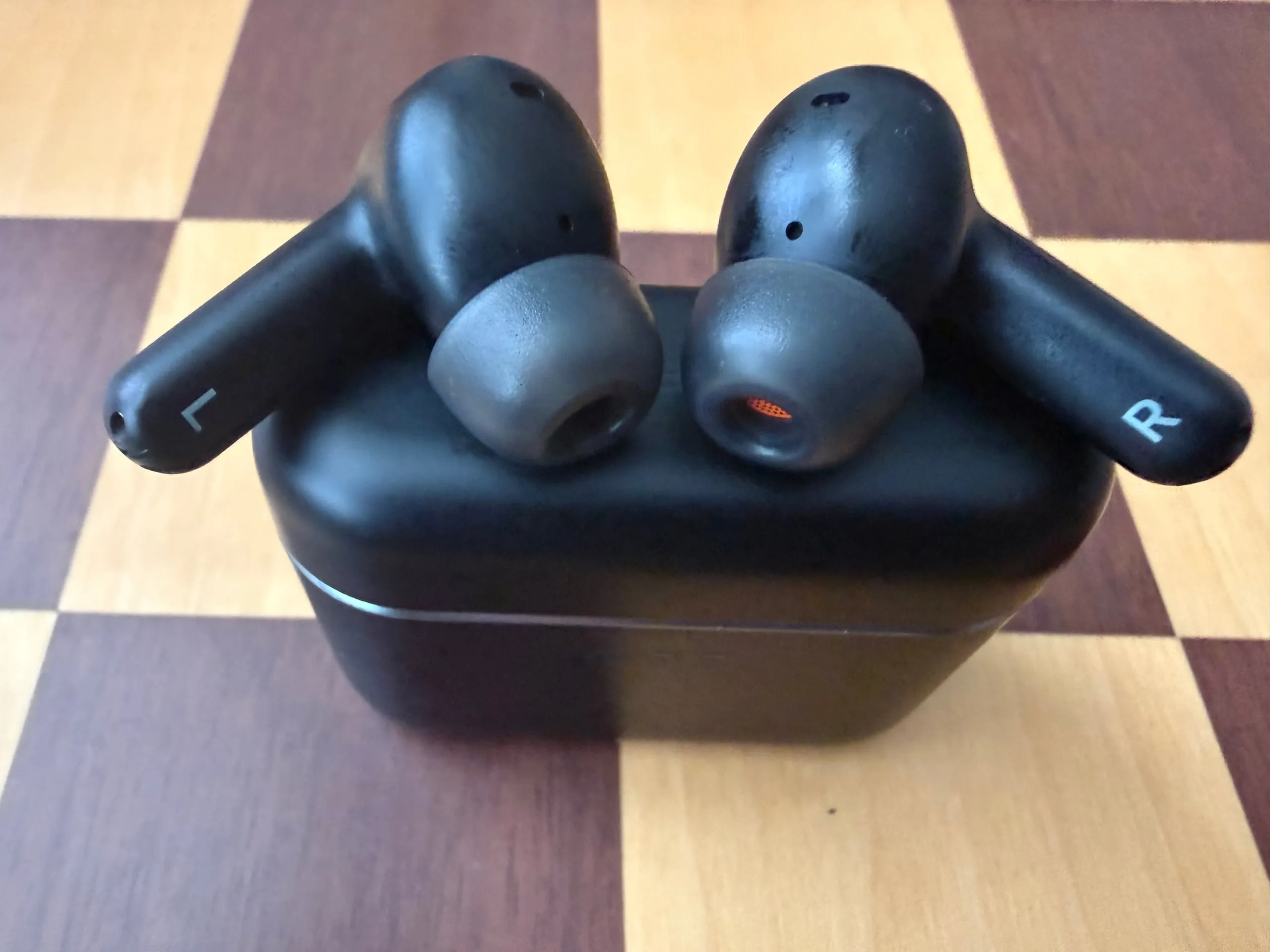
A scene, not a picture
This is the heart of the A100. It's why I keep reaching for it.
Most TWS paint music as a flat picture inside your head. The A100 builds a scene. Instruments are well separated, which is rare for TWS. Nothing feels out of place. Nothing jumps forward to grab your attention. Everything stays in balance.
Nils Lofgren's "Keith Don't Go (Live)" shows it best. The string textures are very good. You feel the people around the stage. The performer and the room stay connected.
Reviewers agree with me most on this point. From research Trusted Reviews compared its stage to an IMAX screen. Next to it, the Sony WF-C710N and EarFun Air Pro 4+ felt like a standard cinema. Tom's Guide called it wide open and natural, with musicians well placed. TechRadar found elbow room for every performer, with clear positions on stage. Loud and Wireless called it layered and deep, a big step up from the M100. Different words, same finding.
Bass: weight that blooms
The bass has real weight. Notes don't just stop. They bloom and decay like a struck drum, with a natural tail. It's full, not bloated. It never muddies the mids. There's more than enough bass, yet it still sits inside the scene. It has space and volume around it. It feels 3D, without darkness.
On Jinjer's "Pisces," the quiet verses are full of fine detail. You hear the soft ghost notes on the snare, not just the main hits. Underneath, the five-string bass has room to breathe. When the heavy sections hit, the low end stays clean.
On Hardwell & Blasterjaxx's "Beat Of The Drum," the tribal drums land with slam and body in both drops. Every hit keeps its tail. On Alle Farben & Tujamo's "Know My Name," the beats hit hard. The low end stays just as controlled.
The EarFun Air Pro 4+ has punch, but no bloom. The A100 has both. That's why I call the EarFun polite and the A100 alive.
Vocals and mids
Very good. I also used Johnny Cash's "Hurt" for the Nothing Ear (2024). Here the voice is close and full. On Bill Callahan's "Diamond Dancer," his deep baritone keeps its definition. It never gets chesty. On My Morning Jacket's "In Color," the voice stays clear inside the reverb.
In my QCC3091 comparison, I gave vocals to the EarFun Air Pro 4+. That still holds for vocal-first listeners. But the A100 isn't far behind. It also puts the voice in a much bigger scene.
Treble
Natural, and the cymbals sound real. On Steely Dan's "Aja," the cymbals keep weight and texture through the whole drum passage. On Dave Brubeck's "Take Five," I used the same ride cymbal as on the Nothing Ear (2024). Here it keeps its body under the shimmer.
Is the top a little relaxed on Flat? Maybe a touch. This isn't an analytical sound. It's a lovely one.
Presets, EQ and DynamEQ
The A100 doesn't need EQ. It sounds excellent out of the box, and the presets cover any need. I listen on Flat most of the time. For less bass and more treble, I switch to Blues.
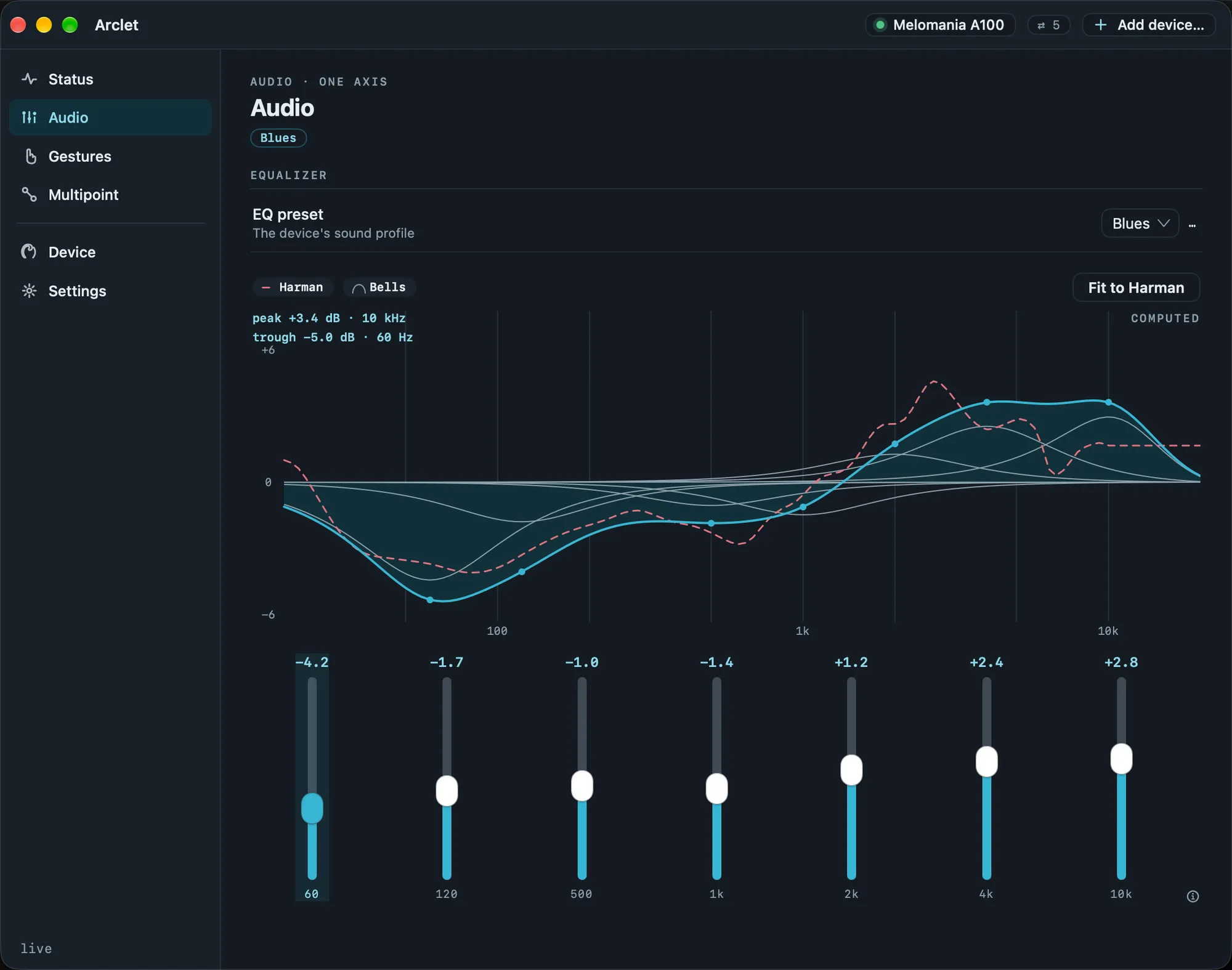
The app has a 7-band EQ. Its sliders show no dB values, only a normalized scale. Using Arclet, I found the real range: −9 to +3 dB. The handy part: any preset can be the starting point for your own tuning.
I did build my own Harman 2019 preset in Arclet. My QCC3091 comparison explains the method. If you know each band's ghost bell, you can fit the curve with the app's 7 fixed bands. Honestly, though, I rarely need it.
I turn DynamEQ on at night. At low volume, it keeps the music full.
The Rock preset breaks the slider limit My finding
This is my own finding. None of the reviews I checked mention it.
The app's EQ sliders show no dB values. Using Arclet, I found they cover −9 to +3 dB. The factory presets don't have to follow that limit. Here's the Rock preset, read straight from the buds:
| Band | 60 Hz | 120 Hz | 500 Hz | 1 kHz | 2 kHz | 4 kHz | 10 kHz |
|---|---|---|---|---|---|---|---|
| Rock preset, dB | +1.4 | +4.8 | +1.1 | +0.4 | +1.4 | +0.8 | −1.7 |
The 120 Hz band sits at +4.8 dB. That's 1.8 dB above what the slider can reach. The app can't show it, so it pins the slider at the top. What you see isn't what you hear.
The bands are also wide (Q about 0.7), so neighbors overlap. The 60 Hz and 120 Hz boosts add up across the whole bass region. It's the ghost-bell effect from my QCC3091 comparison. The real curve is the sum, not the sliders.
The funny part? I don't like Rock. The most interesting preset on these buds is one I'd never listen to. :)
Loudness
Of my three QCC3091 pairs, these are the loudest by a clear margin. I listen at 50–60%. The Soundpeats Air5 Pro+ needs 60–70%, and the EarFun Air Pro 4+ needs 70–80%. Plenty of headroom is left.
From research Loud and Wireless found them about 20% louder than most earbuds. Is the Class A/B amp the reason? Maybe, but I can't prove it.
ANC
Decent+ in the low range. The mids are on par with the Nothing Ear (2024), nothing special. The treble is average. Overall, it's an average ANC that does its job. Nothing to be proud of, nothing to complain about at this price.
I hear little difference between Adaptive and High. So I pick mostly based on battery.
In very quiet rooms, ANC adds a faint, breath-like background. Turn ANC off and it's gone.
From research Tom's Guide also found it blocks low rumble better than higher sounds, like voices and keyboards.
Wind
It isn't windproof. In strong gusts I hear a soft splash in the low range, like a phone call breaking up a little. It's not drastic, and it's much more tolerable than the Nothing Ear (2024), where gusts came through as high-pitched splashes and wind was the ANC's real weak spot.
Transparency
It's an awareness mode, nothing more. You'll notice what's around you. But it doesn't let you speak freely. With music playing, you can't clearly follow what people say. For a real conversation, take a bud out.
Calls
A bit behind the Nothing Ear (2024). In noisy places, my voice still gets through. Fine for everyday calls, but not the pick for heavy call users.
Battery
| My result (ANC on, AAC) | Research (test conditions differ) |
|---|---|
| About 6 h at 50–60% volume | From research Loud and Wireless got 5–6 h at 40% and called it average at best. |
That's close to Cambridge's 6.5-hour rating. For a Class A/B design, that's good.
Comfort and fit
Great, though not my most comfortable pair. The Nothing Ear (2024), Huawei FreeBuds Pro 4, Soundpeats Air5 Pro+ and EarFun Air Pro 4+ feel a bit nicer. But I don't feel tired wearing the A100, even in long sessions. Medium tips seal well for me.
From research Stereo Guide notes the A100's nozzles are elliptical, not round. It also says the small tips feel more like medium. If you have small ear canals, try them on first.
App and controls
The app is convenient. It lets you remap every touch control. I put volume up and down on tap-and-hold.
Touch is reliable, and the touch area is easy to find. There's no volume swipe. With remapping, I don't miss it.
The one catch comes from the case. Its magnets are strong, so pulling a bud out takes a firm grip. Now and then my finger lands on the touch surface and switches the ANC mode. At first I blamed wear detection, but it's the touch control.
Wear detection and the case
Wear detection is reliable in the ear.
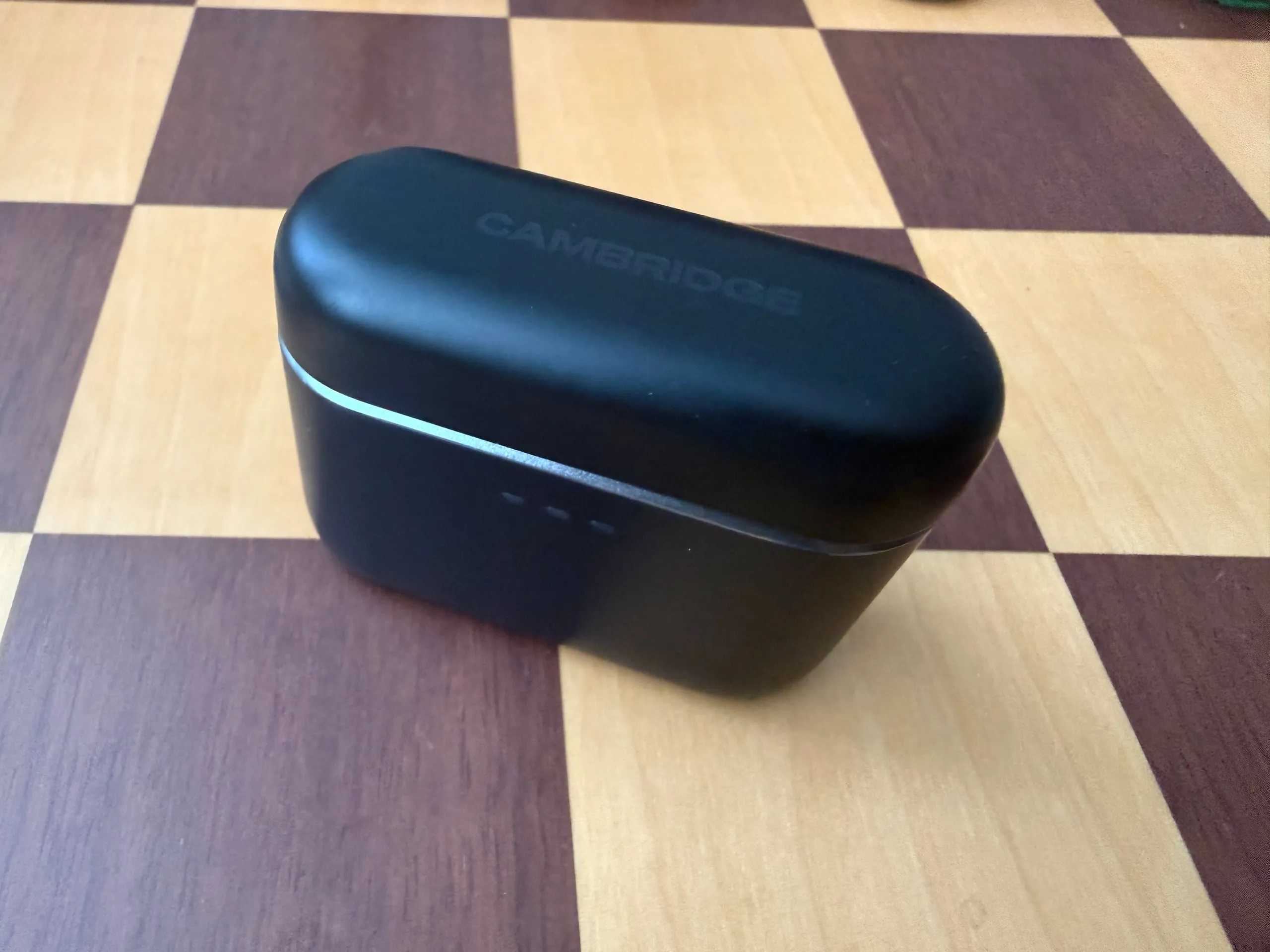
The case looks very good, with a matte finish. Wireless charging works.
Firmware
Early on, I had dropouts and some delay. Firmware updates fixed both, and it's been stable since. I never had pairing trouble.
Codecs and connectivity
AAC sounds good, so iPhone users have nothing to worry about. On a dongle, I prefer aptX, as on all three QCC3091 pairs.
From research Cambridge confirms that since firmware 1.2.2, turning on LDAC in the app disables multipoint. On AAC, multipoint works fine for me.
One rare convenience for dongle users: the app keeps working on the iPhone while the buds play through the Questyle dongle.
A100 or A100SE?
From research The new A100SE costs $149 / £129 / €149. It adds Dolby Audio and a blue finish. The Dolby processing runs in the buds, not the phone. So it works with any device, iPhone included. Dolby Atmos isn't supported. The amp, driver, codecs and the 39 h total battery are unchanged. Reports differ on whether the tuning changed.
Spatial processing aims to widen the stage. The A100 already gives me a real scene without it.
If Dolby spatial audio doesn't matter to you, I see no reason to upgrade. Buy the original on sale.
Where reviewers disagree with me
Most of these reviews came out in mid-2025, on launch firmware. Stuff even tested a pre-release app. I started in early 2026, after several updates. I can't prove firmware explains any single gap. Still, keep it in mind. Reviewers often split among themselves too, so for each point I say which group I'm closer to, and where I differ from it.
- Default tuning. From research Headphonecheck heard too much sub-bass out of the box. It called EQ necessary. On Flat, I partly agree: there may be a bit much. But the bass never bothers me, especially on rock, metal and EDM. The likely cause is taste and seal. Headphonecheck wants a flatter reference sound, and I like weight. A tight seal also lifts the sub-bass. So the same buds can sound heavier in one ear than another. Reviewers split on this: Simon Lucas (TechRadar and Expert Reviews) found the tuning neutral, not bass-driven, and Loud and Wireless found the bass tight and controlled, with no bleed into the mids. I'm closer to them, though I hear a little more weight than "neutral" suggests.
- Detail vs. scene. Trusted Reviews found the Sony WF-C710N and EarFun Air Pro 4+ more revealing. It would pick them. On detail alone, I partly agree. The A100 isn't an analytical pair, and the EarFun is more vocal-focused. But the same review found the A100's stage far bigger. That's what I value most. We agree on the facts, not the priority. Others rate its detail higher: Simon Lucas put its insight among the best in its class, and Loud and Wireless found it reveals subtle details most earbuds miss. I sit between the two camps: plenty of detail, but the scene is what wins me over.
- Low-end integration. Simon Lucas heard the lowest bass as slightly detached from the lower mids. I don't hear it. In my QCC3091 comparison, I found its single driver the most coherent of the three. He's the only reviewer who mentions it, and he calls the effect slight. Seal matters here too. A small leak drops the deepest bass more than the bass above it. That can make the two feel separate. He also listened over hi-res codecs from a FiiO player, as well as an iPhone. I mostly use AAC. Stereo Guide heard it the other way, a tuning so even that it forgot it was wearing headphones. I'm with Stereo Guide here.
- ANC off. Stereo Guide found the bass punchy only with ANC on. Without ANC, it sounded a little thin. With ANC off, I hear maybe a bit less, but never a lack of bass. The likely cause is fit. Stereo Guide itself warns the tips don't suit everyone, and the small ones run large. With a weaker seal, ANC off costs more bass. Stereo Guide also noted the tuning changes with ANC on, so some difference is expected. Loud and Wireless heard the same character in every mode. I'm closer to Loud and Wireless, with a small drop in bass that Stereo Guide's fit made much bigger.
- Treble. Tom's Guide heard a slight roll-off at the top. We mostly agree: maybe a touch on Flat. They fixed it with a small treble lift. I don't feel the need. That's taste: I prefer lovely over analytical. On the rest, reviewers agree with each other and with me: Tom's Guide found no high-end fatigue, Stereo Guide heard no sharpness, and Headphonecheck none once tuned.
- Wind. Stuff found gusts made music hard to hear. I hear only a soft, low splash in strong gusts, never enough to drown the music. Stuff tested a pre-release app at launch. The A100 has wind noise reduction, and firmware can improve it. Fit and the wind itself vary too. Reviewers split by omission: Stuff is the only one I found who reports wind trouble firsthand, while Trusted Reviews (several months across all kinds of transport) and TechRadar (indoors and outdoors) don't flag wind at all. I'm in between: not trouble-free, but nowhere near Stuff's experience.
- Idle noise. Loud and Wireless heard a faint buzz with nothing playing. On my unit it's softer: with ANC on, I hear a faint, breath-like background in quiet rooms. With ANC off, it disappears. So we partly agree. It's there, but on mine it's a soft breath, not a buzz, and it comes from the ANC. High-frequency hearing varies a lot between listeners. Units and firmware may differ too. Loud and Wireless is alone on this one. None of the other reviews I checked mention it, including TechRadar, which also listened in very quiet places.
- Adaptive ANC. Loud and Wireless found Adaptive kept dropping to a weaker level, even in the same noise. I see little difference between Adaptive and High. Adaptive reacts to the environment. Steady loud noise and my everyday mix can behave differently. Their review also came out before some of my updates. Headphonecheck found the adaptive noise cancelling effective. My experience is closer to Headphonecheck's.
- Transparency. Tom's Guide called it natural. For me, it's an awareness mode. We tested different things. Tom's Guide judged how natural voices sound, like a shop clerk or bus driver. I judge whether I can follow people with music playing. Both are true. Reviewers split here as well: Loud and Wireless found it still occluded, with your own voice muffled, and Stuff preferred turning ANC off to stay aware. I'm in their group.
Verdict
So, hi-fi in a stem? For sound, yes.
The Melomania A100 scores 10/10 for sound and 8/10 overall. Above all, it gives you a scene, not a picture. Instruments are well separated, nothing is misplaced, and everything stays in balance. Almost every reviewer agrees on that. The bass has real weight and blooms like a struck drum. The treble is natural. It sounds excellent out of the box. You also get a convenient app, reliable controls, wind handling far better than the Nothing Ear (2024) and a good-looking case.
ANC and calls are average. Transparency is below average. That keeps it at 8/10.
At about $99 on sale, it's a bargain for this sound. It's the pair I'd keep.
Some people should still skip it:
- Anyone who needs top-tier ANC. It's decent in the lows and average elsewhere.
- Anyone who relies on transparency to talk. It's only an awareness mode. It doesn't let you speak freely.
- Spatial audio fans. Look at the new A100SE instead. Its Dolby Audio works with any phone.
If none of those is a dealbreaker, the answer is simple. Yes, this is hi-fi in a stem. It doesn't play you a picture. It puts you in front of the stage.
Take care, everyone. If you've read this far, I hope it helped. :)