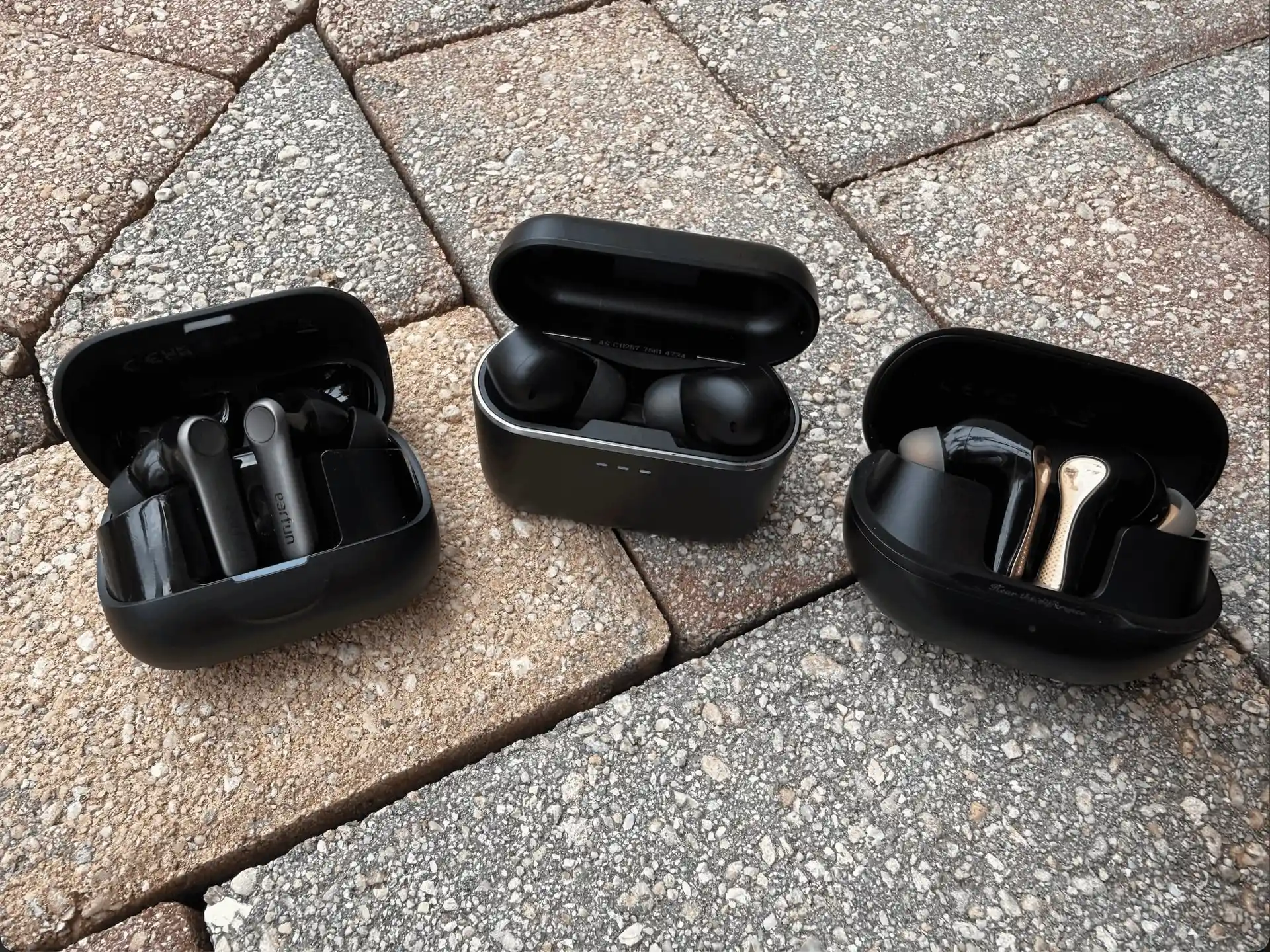
I've used these three pairs for a long time, and they have one thing in common: the Qualcomm QCC3091 chip. So I wanted to see how far apart the same silicon can end up.
Why these three
From research The QCC3091 belongs to Qualcomm's Snapdragon S3 family. Qualcomm splits its earbud chips into three tiers: S3 for mid-tier, S5 for premium and S7 for ultra-premium. But Qualcomm's own pitch for the QCC3091 is about bringing audiophile-level sound down to this tier: 24-bit/48 kHz aptX Lossless and an improved DAC. It's a dual-core chip with programmable ANC and support for aptX, aptX Adaptive and aptX Lossless. In short: top-tier sound features at mid-range prices.
Qualcomm also pitches the chip as a way for brands to differentiate their products, with access to Qualcomm's technologies and developer program. Keep that in mind, because that's exactly what happened here.
That's where the similarity ends. The Bluetooth version differs: From research the Cambridge Audio Melomania A100 and Soundpeats Air5 Pro+ run Bluetooth 5.4, while the EarFun Air Pro 4+ runs 6.0. The firmware differs too. Soundpeats clearly doesn't just ship Qualcomm's reference implementation. Its custom firmware is what makes a parametric EQ possible (thanks, Soundpeats, I will buy your products again!). I assume EarFun also runs its own firmware. And the amplifiers differ.
| Cambridge Audio Melomania A100 | Soundpeats Air5 Pro+ | EarFun Air Pro 4+ | |
|---|---|---|---|
| Bluetooth | 5.4 | 5.4 | 6.0 |
| Firmware | Cambridge | Custom (parametric EQ) | Custom (assumed) |
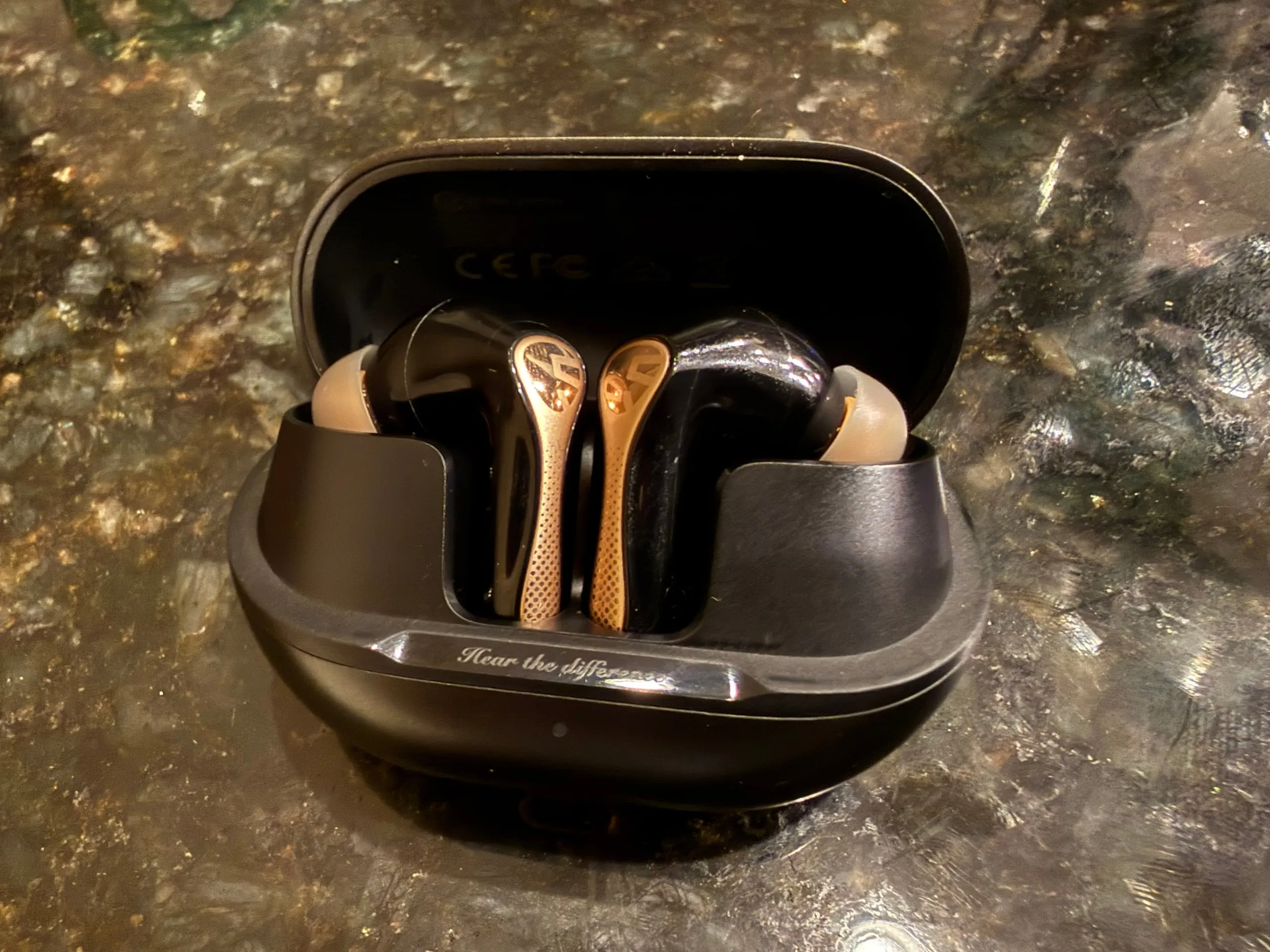
| Drivers | 10 mm dynamic | 10 mm dynamic + xMEMS | 10 mm dynamic + balanced armature |
| Crossover | None (single driver) | Not confirmed (the xMEMS Cowell is sold as full-range capable) | Likely (from measurements) |
| Amplification | Class A/B | Dedicated Class-H amp for the xMEMS | Not disclosed |
| Weight per bud | 4.7 g | 5 g | 5.2 g |
| Price (approx.) | $149 / £119 / €139 (often ~$100 on sale) | ~$129 (often ~$70 on sale) | $99.99 (~$70 on sale) |
From research Soundpeats pairs the xMEMS with its own Aptos XAA-2000 Class-H amplifier. The Cambridge Audio Melomania A100 often drops to around $100 on sale, and Cambridge's own EU store currently lists it at €89.
How I tested
- Long-term use, not week-one impressions.
- Stock tips. Most buyers use what's in the box.
- iPhone over AAC by default; Questyle dongle for aptX and LDAC. LDAC works on the Soundpeats Air5 Pro+ and EarFun Air Pro 4+ only. On my iPhone-only setup, the A100 gets aptX.
- ANC on for everything. That's how I listen every day, since I don't want outside noise. This matters, because ANC changes the sound on some pairs (more on that below). If you listen with ANC off, expect a different balance.
- I didn't volume-match codecs or pairs, so treat codec impressions as listening preferences, not a controlled test.
- My own Mac software, which I explain below.
- I checked my impressions against published reviews. Where reviewers disagree with me, I say so. Anything I haven't tested myself is marked From research.
Loudness
These three are not equally loud. My normal listening level on the iPhone:
| Pair | Volume I use |
|---|---|
| Cambridge Audio Melomania A100 | 50–60% |
| Soundpeats Air5 Pro+ | 60–70% |
| EarFun Air Pro 4+ | 70–80% |
The Cambridge Audio Melomania A100 is the loudest by a clear margin. That fits the Class A/B story, though I can't prove the amp is the reason. The EarFun Air Pro 4+ is the quietest, and I run it the highest. Keep that in mind: louder almost always sounds better, so loudness can skew comparisons. It also costs the EarFun Air Pro 4+ some battery life.
EQ: the part that really separates them
My sound philosophy first. There's no ideal sound signature. It's like music taste: one person loves rap, another doesn't. Every brand has its own idea of a good default. Some aim at bassheads, others at neutral.
So I judge earbuds on three layers:
- Taste: do I like the default sound?
- Measurable quality: frequency response, distortion, and how smoothly the drivers hand off.
- Correctability: how far the EQ lets me bend the default toward my taste.
For me, the third layer often decides. Here's what each pair offers:
| Pair | Built-in app | What my software adds |
|---|---|---|
| Cambridge Audio Melomania A100 | 7 fixed bands, no dB scale (−9/+3 dB, measured with my software) | More gain range, a plotted summed curve, Harman 2019 matching |
| Soundpeats Air5 Pro+ | 10 bands, adjustable Q, fixed centers, ±6 dB | ±12 dB, movable center frequencies, Q factor, Harman 2019 auto-match |
| EarFun Air Pro 4+ | 10-band graphic (±10 dB) + 10-band true parametric "Professional EQ" with a preamp | Nothing (the app's Professional EQ already covers it) |
The Soundpeats Air5 Pro+ has a hidden trick. From research The blue SoundPeats app (not PeatsAudio) lets you adjust Q per band: open the custom EQ in edit mode, then press and hold the three-dot button. My software writes through the same mechanism, but it doubles the gain range to ±12 dB, lets me move the center frequencies, sets Q for every band, and can auto-match the curve to Harman 2019.
The EarFun Air Pro 4+ already has the most capable in-app EQ of the three. For each of its 10 Professional EQ bands, you set the filter type, frequency, gain and Q, and there's a master gain (preamp) to avoid clipping. What it lacks is usability, since you step every value with plus and minus buttons.
Ghost bells, explained
Each EQ band is a bell-shaped filter. Apps show you a slider, but not the width of the bell. Neighboring bells overlap, so the real gain at any frequency is the sum of several bands, not the number on the slider. Two sliders at +3 dB can give you more than +3 dB between them.
I call these hidden shapes "ghost bells." Once you know each band's center and shape, you can plot the summed curve and see the true total gain. That's how I fit the Cambridge Audio Melomania A100 to Harman 2019 within the app's own 7 fixed bands. It also takes a starting point: my software includes the earbuds' frequency response from publicly available measurements, then works out the band gains so the summed curve lands on the target. The same summing is why EQ that looks mild in an app can sometimes boom or clip.
Bass
| Pair | Bass |
|---|---|
| Cambridge Audio Melomania A100 | Best timbre: rich, punchy, natural. More like real sound than a painted picture. |
| Soundpeats Air5 Pro+ | Very good. |
| EarFun Air Pro 4+ | Restrained and controlled out of the box, which takes some excitement out. But the bass is there, sub-bass included. |
The EarFun Air Pro 4+ point matters. It has extension but not emphasis, so one boost fixes it: about +5 dB around 60 Hz in the app's 10-band EQ. That brings the excitement back right away.
From research ANC changes the EarFun Air Pro 4+ sound. ReganCipher measured more low-end thump and a more V-shaped signature with ANC on. Since I listen mostly with ANC on, I think this is the "bassiest" version and still found it polite. With ANC off, expect even leaner bass.
Treble
| Pair | Treble |
|---|---|
| Soundpeats Air5 Pro+ | Bright and crisp out of the box. After Harman matching, the crispness stays and the extra brightness goes. |
| Cambridge Audio Melomania A100 | Natural timbre, cymbals with real weight. |
| EarFun Air Pro 4+ | Very natural, but the upper mids and treble are under-emphasized in the default preset. |
On the Soundpeats Air5 Pro+, the brightness comes from the stock tuning, and the crispness seems to come from the driver. Fix the tuning and the crispness survives. That's why this pair rewards EQ more than any other here.
A note on dual drivers
In my view, a second driver doesn't bring much beyond each brand's attempt to hit a specific signature. It's a tuning tool, not a quality guarantee. The Cambridge Audio Melomania A100 proves the point: one dynamic driver, no crossover, and the most coherent timbre of the three.
The Soundpeats Air5 Pro+ is an odd case. From research xMEMS sells the Cowell as full-range capable in sealed earbuds, and I found no proof that Soundpeats uses a crossover at all. However it's wired, the crispness survives my Harman EQ, and what really makes this pair shine is how far the EQ lets you correct it.
The EarFun Air Pro 4+ likely does use a crossover. From research ReganCipher measured a small spike near 5 kHz that probably marks it and could make some hi-hats and cymbals a little less tight.
Soundstage and imaging
| Pair | Stage |
|---|---|
| Cambridge Audio Melomania A100 | The best of the three. Simply good. |
| Soundpeats Air5 Pro+ | Quite wide, but shallow. |
| EarFun Air Pro 4+ | Narrow and vocal-centric. Lovely, but crowded in busy tracks: the instruments pile up in a small space. |
From research NerdyHiFi described the Soundpeats Air5 Pro+ stage as intimate, but found its imaging and spatial cues quite strong. "Wide but shallow" is how I'd reconcile that.
Codecs
All three support the same codecs, so any difference comes from implementation. On all three I prefer aptX. Don't ask why: it just sounds smoother and softer. AAC sounds louder. I prefer aptX even though it's quieter, so I don't think it's just a loudness effect.
LDAC and multipoint don't mix on any of these:
- From research On the Cambridge Audio Melomania A100, multipoint turns off when you enable LDAC in the app. The LDAC toggle is Android-only, added in the February 2026 firmware. On an iPhone, the A100 tops out at aptX through a dongle.
- From research On the Soundpeats Air5 Pro+, LDAC can disable dual connection and game mode.
- On the EarFun Air Pro 4+, LDAC runs with one device only. Switching between aptX and LDAC in the app also reboots the buds.
One rare convenience for dongle users: all three apps keep working on the iPhone while the buds play through the Questyle dongle. So you can still manage the buds from the app.
Battery (ANC on)
| Pair | My result | Research |
|---|---|---|
| Cambridge Audio Melomania A100 | About 6 h at 50–60% (rated 6.5 h) | – |
| Soundpeats Air5 Pro+ | Under 4 h on AAC, even less on aptX | From research NerdyHiFi got 4.5–5 h on AAC and about 3 h on LDAC. |
| EarFun Air Pro 4+ | 6–6.5 h on AAC | From research ReganCipher measured 6 h 19 min on AAC. |
The Soundpeats Air5 Pro+ is the weak spot. The xMEMS needs its own amplifier, driven at tens of volts, while standard drivers run on a few volts from Class D amps. That costs battery.
Apps
- Cambridge Audio Melomania A100: the most complete and polished. A very good experience end to end. DynamEQ keeps music balanced at low volumes, and you can toggle it in the app. From research One reviewer found that modified custom EQ presets can't be deleted or re-saved under the same name.
- EarFun Air Pro 4+: looks good but is less polished. It requires a login. The Professional EQ is excellent. The preset gallery is bloated and poorly organized; I'd rather have fewer presets that I can edit.
- Soundpeats Air5 Pro+: requires a login. The Q adjustment is hidden. From research NerdyHiFi reported frequent reconnects when opening the EQ or toggling LDAC and game mode.
I had zero disconnects on any of the three.
From research Latency: ReganCipher measured the EarFun Air Pro 4+ at 234 ms normally and 113 ms in gaming mode, while the Soundpeats Air5 Pro+ hit 81 ms in gaming mode.
Everything else
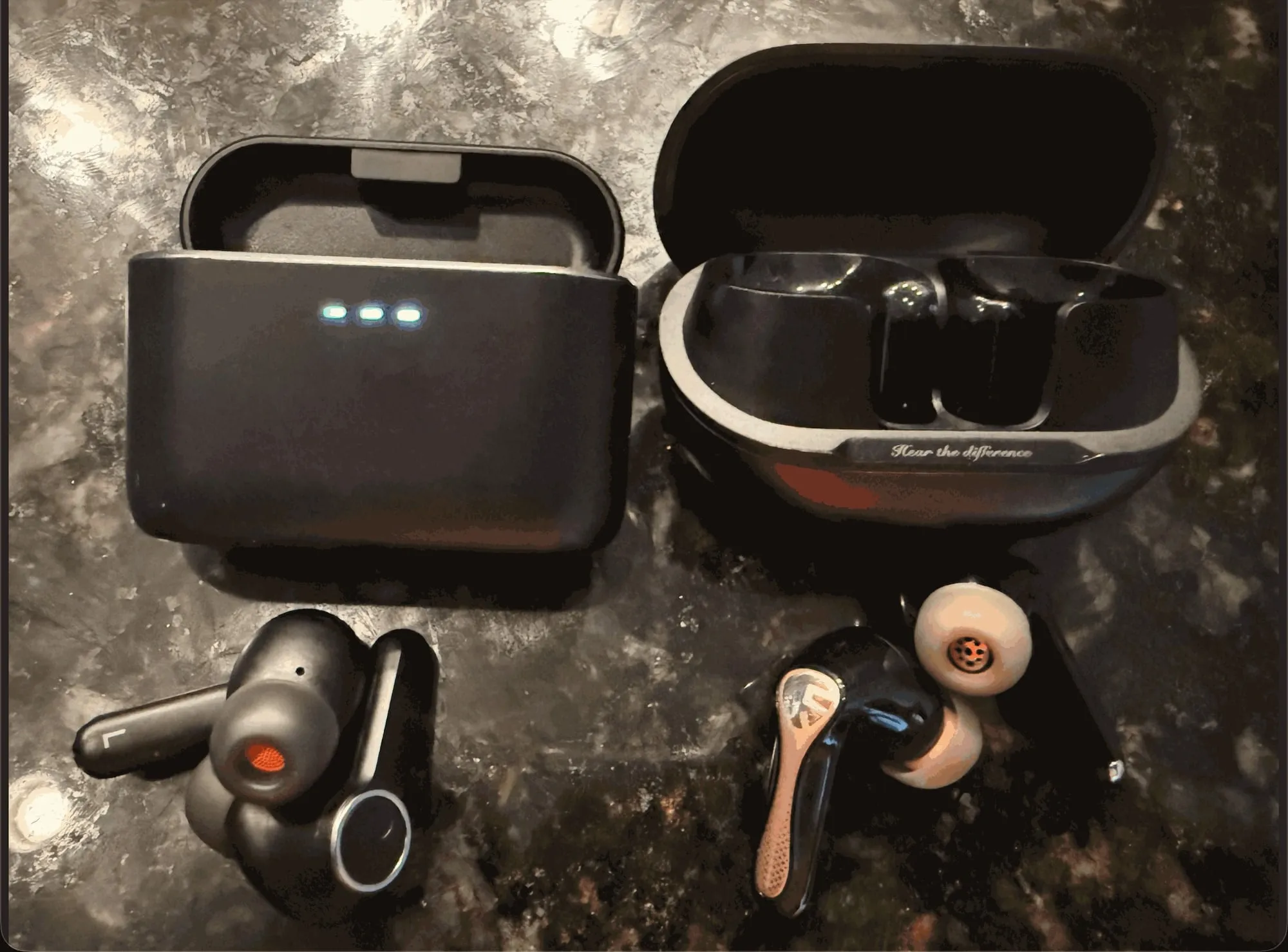
- Comfort: the Soundpeats Air5 Pro+ and EarFun Air Pro 4+ are among the most comfortable in-ears I own. The EarFun Air Pro 4+ is very light and seals like a glove on the default tips. Both are clearly more comfortable than the Cambridge Audio Melomania A100, which is still great.
- ANC: the Soundpeats Air5 Pro+ is slightly ahead of the Cambridge Audio Melomania A100; fit may give it the edge. The EarFun Air Pro 4+ is close, strongest in the mids and upper mids. Its wind noise reduction setting stops gusts from coming through as noise, but it weakens the ANC.
- Transparency: the Soundpeats Air5 Pro+ is mid-pack. The Cambridge Audio Melomania A100 and EarFun Air Pro 4+ are meh. I'd call them awareness modes: with music playing, you can't clearly hear what people are saying.
- Calls: the Cambridge Audio Melomania A100 and Soundpeats Air5 Pro+ are mid-pack. The EarFun Air Pro 4+ is usable in quiet places, but in loud places its AI processing makes my voice sound bad, and the mic catches wind easily.
- Wear detection: the Cambridge Audio Melomania A100 has it. The Soundpeats Air5 Pro+ has none. On the EarFun Air Pro 4+ it's hit and miss: I think my fingers sometimes cover the sensor when I take a bud out, so the music keeps playing.
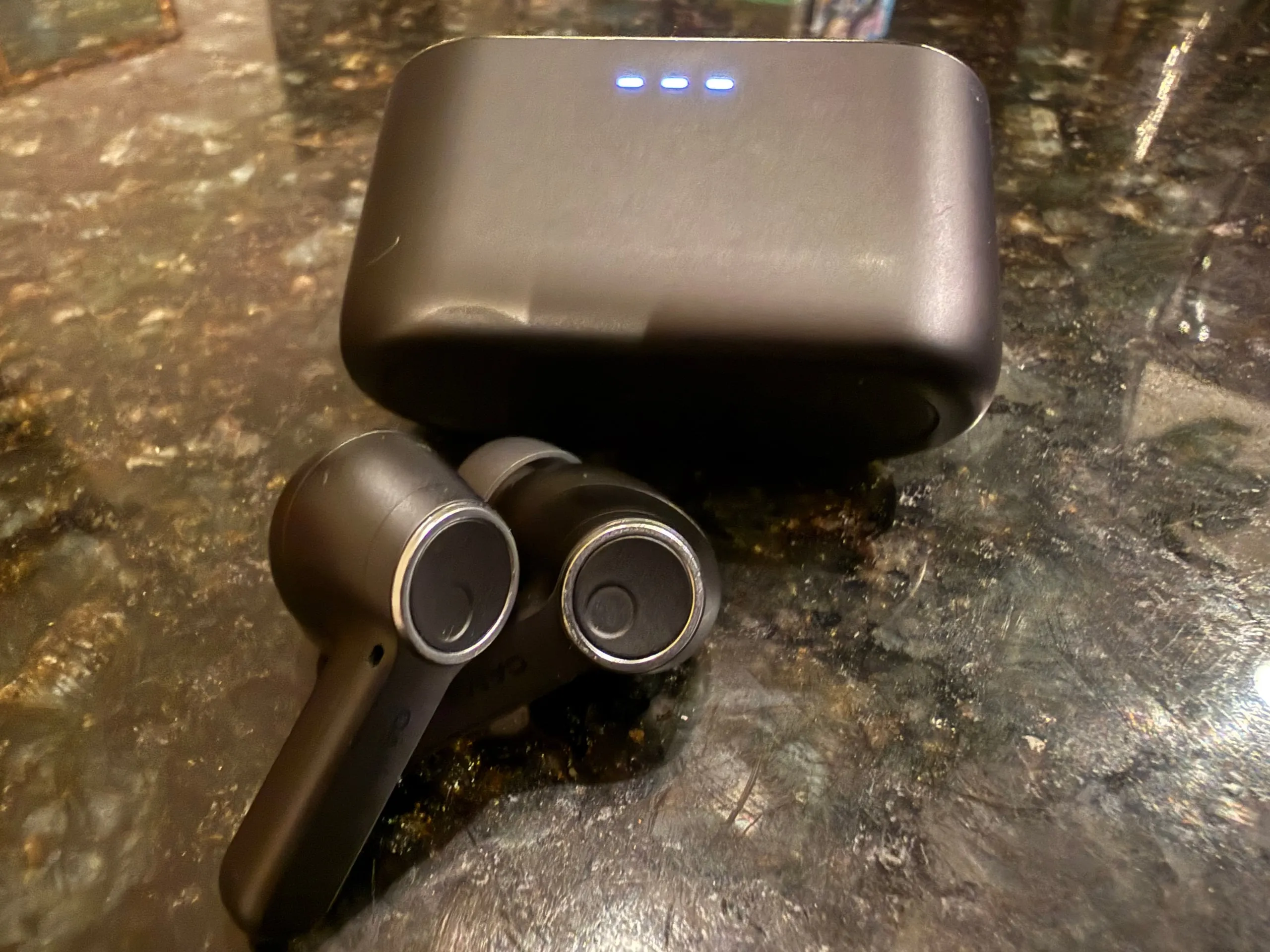
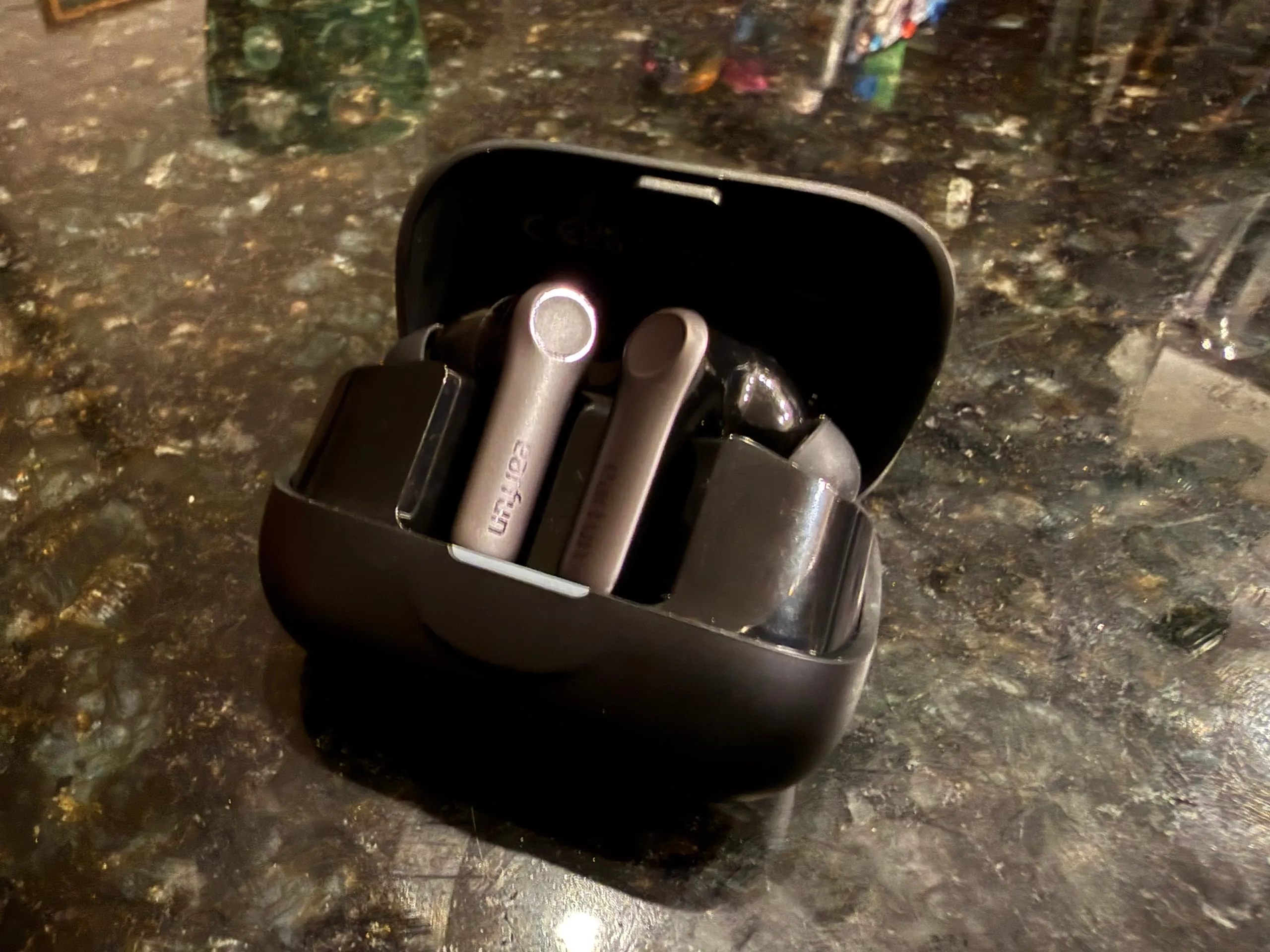
- Cases: the Cambridge Audio Melomania A100 has a great case with wireless charging. The EarFun Air Pro 4+ has wireless charging and doesn't squeak, but the material doesn't look premium. The Soundpeats Air5 Pro+ case is well made and looks good and I like it, but it has no wireless charging.
Where reviewers disagree with me
- Cambridge Audio Melomania A100: Headphonecheck found the stock tuning over-emphasized in the sub-bass and called EQ correction necessary. I love the default sound. Both views can be true. It's a taste question, and the EQ can fix it either way. One reviewer also found the bass punchy only with ANC on, and a little thin without it.
- Soundpeats Air5 Pro+: my battery numbers are lower than NerdyHiFi's. Volume, codec and my unit may explain it.
- EarFun Air Pro 4+: we agree on the facts, not the feeling. Pragmatic Audio describes the mid-bass as restrained with punch but no bloom, GSMArena found it not bloated, and Tom's Guide called it rich without being muddy. I hear the same clean, controlled bass. I just find it a bit too polite without EQ. The soundstage splits reviewers too: MajorHiFi, Scarbir and Loud and Wireless found it compact, while Pragmatic Audio and Tom's Guide praised its separation. I'm with the first group. From research Scarbir noted that at higher volumes it fills the midrange more than its rivals. I listen fairly loud, so that may be part of why busy tracks feel crowded to me.
Verdict
There's no single winner, because each one wins for a different listener.
- EarFun Air Pro 4+ for vocals. Natural, detailed mids, controlled bass, and the most capable app EQ here.
- Cambridge Audio Melomania A100 for bass, strings, live recordings and stage. Rich, velvety timbre, very good treble, the loudest of the three, and the most polished app. It's the one I'd keep.
- Soundpeats Air5 Pro+ for people who like to tune. It needs the most work, but after Harman EQ it sounds near perfect. The price is battery life and no wear detection.
Same chip, three philosophies. The QCC3091 is only the starting point. Bluetooth version, firmware, amplifier, drivers and tuning all differ, and everything you actually hear comes from what each brand built around the chip.
Take care, everyone. If you've read this far, I hope it helped. :)