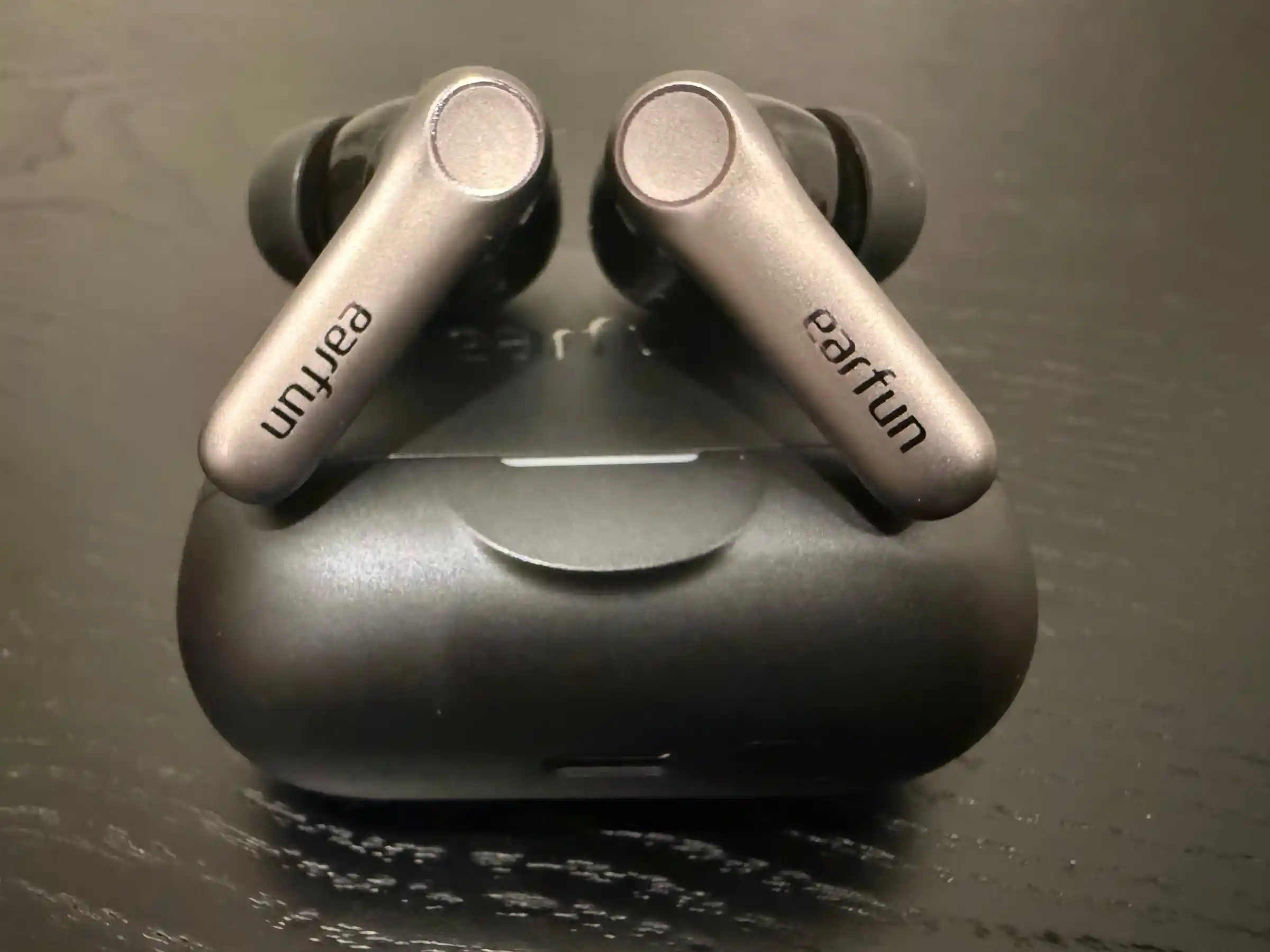
Why this pair
I've lived with the Air Pro 4+ for 4–5 months. In my QCC3091 comparison, I gave it the win for vocals. This review explains why, and where it falls short.
To be honest, for sound it's my least favourite of my three QCC3091 pairs. It isn't bad. It's very steady and naturally good. But next to the others it feels a bit too normal. And that's exactly why the voice stands out: it's the one thing that steps forward.
What's inside
From research EarFun is open about the chip and the drivers.
| Spec | EarFun Air Pro 4+ |
|---|---|
| Drivers | 10 mm composite dynamic + balanced armature ("FeatherBA") |
| Chip | Qualcomm QCC3091 |
| Bluetooth | 6.0, multipoint (2 devices) |
| Codecs | SBC, AAC, aptX Adaptive, aptX Lossless, LDAC, LC3 |
| Weight per bud | about 5 g |
| Battery (rated) | 8 h ANC on, 12 h ANC off; 36 h / 54 h with case |
| Microphones | 6 (3 per bud) |
| Protection | IP55 |
| Charging | USB-C, wireless |
| Price | $99.99 at launch, often ~$71–80 on sale |
Compared with the Air Pro 4, the 4+ adds the balanced armature and moves to Bluetooth 6.0 and IP55. It also has a new front-opening case and oval tips. The chip and the ANC claim stay the same.
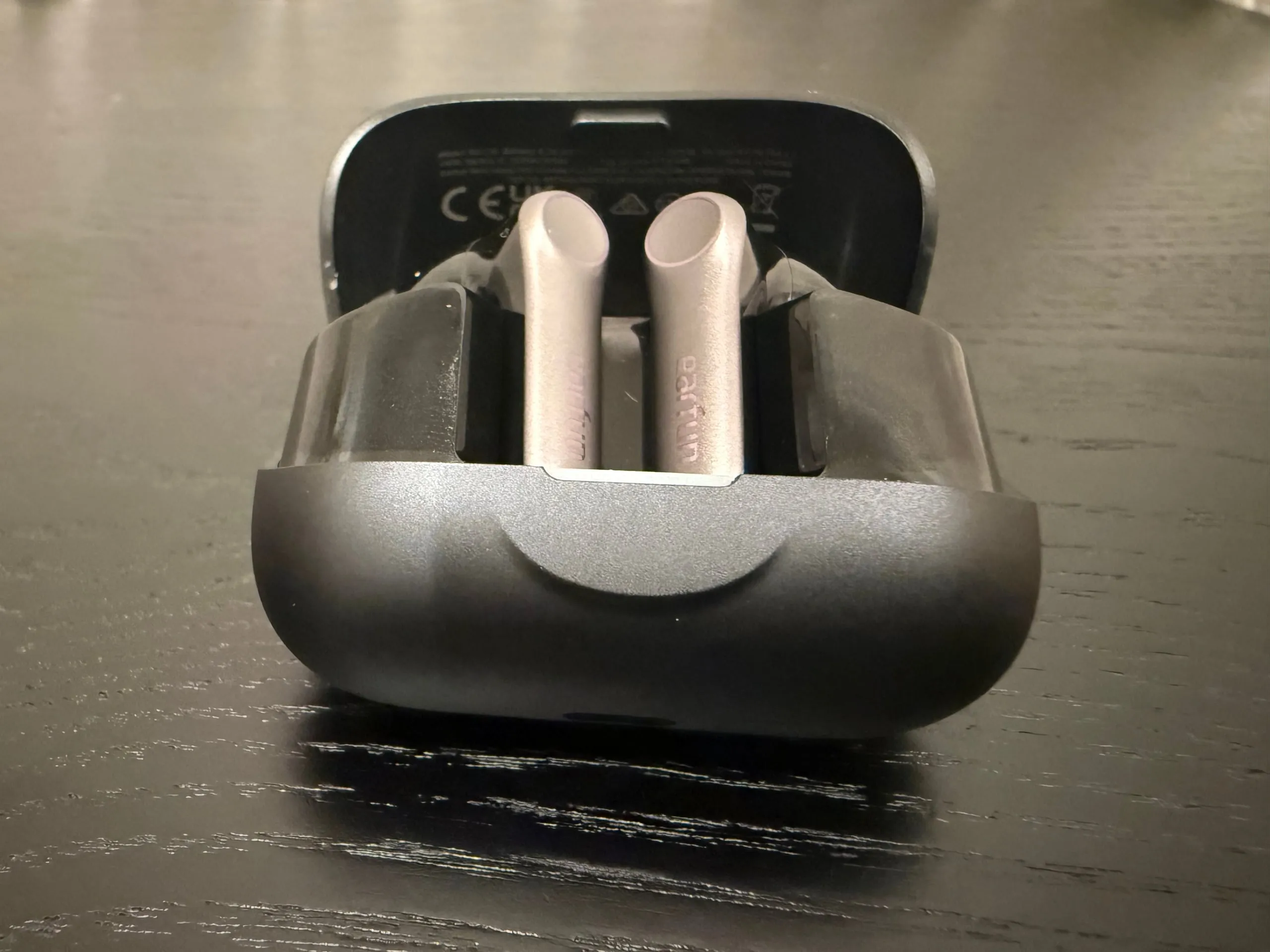
How I tested
- Long-term use, about 4–5 months, since around late May or June 2026. I started on an earlier 1.3.x firmware and I'm now on 1.3.7.
- Stock tips: the pair fitted at the factory, one size below large. Several sizes come in the box.
- iPhone over AAC. Questyle dongle for aptX.
- Mostly the default preset. On EDM, I adjust the bass.
- ANC off most of the time. More on why below.
- Volume: 70–80% on the iPhone.
I checked my impressions against published reviews. Where reviewers disagree with me, I say so. Anything I haven't tested myself is marked From research.
The voice comes first
This is the strong side of these buds. Voices are forward, and they have very good resolution. You hear the fine detail in them.
On Chris Stapleton's "Tennessee Whiskey," his voice isn't harsh at all. The grit is there without the edge. But I did want less bass here. I switched to the Bass Reduction 2 preset and turned ANC off.
On Norah Jones's "Don't Know Why," she's very close. Every detail is revealed. Maybe too much: the upper range is a little bright, and she sounds too intimate. I'd like her to sing a step further away. From research Part of that is the recording. Come Away with Me is famously intimate, and critics noted that her voice dominates the record. But the buds bring her even closer. ReganCipher's measurements show a strong presence lift around 3 kHz and a peak near 7 kHz, even with ANC off. That's where breath and closeness live.
So the voice wins. Sometimes it wins a little too much.
Stage: people inside your head
The stage is narrow. I used Nils Lofgren's "Keith Don't Go (Live)" as a reference. Here the people around the stage are clamped inside your head. The room collapses, and textures stand out less. There's no excitement in it.
The voice still stays good and forward in that small space. That's the trade-off of these buds.
Bass: punch without bloom
There's plenty of bass, and you can tune it. But the excitement isn't there.
Out of the box, there's plenty of bass. It punches, and it stays controlled, but notes don't bloom after the hit. On Chris Stapleton I wanted less of it. On rock and metal, it mostly works as is. On EDM, it's too controlled: there's quantity, but not excitement.
In my QCC3091 comparison, I said about +5 dB around 60 Hz brings the excitement back. That still holds, partly: it adds some excitement. But a better bass needs more tuning than one boost. And even with my own curve, it gets better, but not close to the Nothing Ear (2024) in the bass department.
Push it too far, and it starts to sound like a car with an aftermarket subwoofer. The lows get harsh and flat, with no 3D space around them.
From research Most reviewers hear the same tight, controlled low end. Pragmatic Audio found "punch without bloom," RTINGS called the kicks "well-controlled" while measuring about +4 dB of bass, and Scarbir heard "tight and deep hits." A few disagree. MobileSyrup found it bass-heavy, and audioreviews.org found it thin.
If you like controlled punch, you'll be happy. If you want bass that blooms, look elsewhere.
Treble: the tail is in the cymbals
Cymbals sound right. They don't have the weight I hear on the A100, but they're not thin either. Resolution is good. On Dave Brubeck's "Take Five," the very last hit has a long, long tail. That's good.
It's an interesting contrast. The treble decays naturally. The bass doesn't. Maybe that's the balanced armature at work. I can't say for sure.
Presets, EQ and the hidden Professional EQ My finding
The app has a 10-band graphic EQ (±10 dB), a hearing test ("My Sound Profile") and a big gallery of presets. The gallery is bloated and poorly organized. I'd rather have fewer presets that I can edit.
The real gem is hidden: the Professional EQ. It's a true 10-band parametric EQ. For each band, you set the filter type, frequency, gain and Q. A master gain (preamp) keeps boosts from clipping.
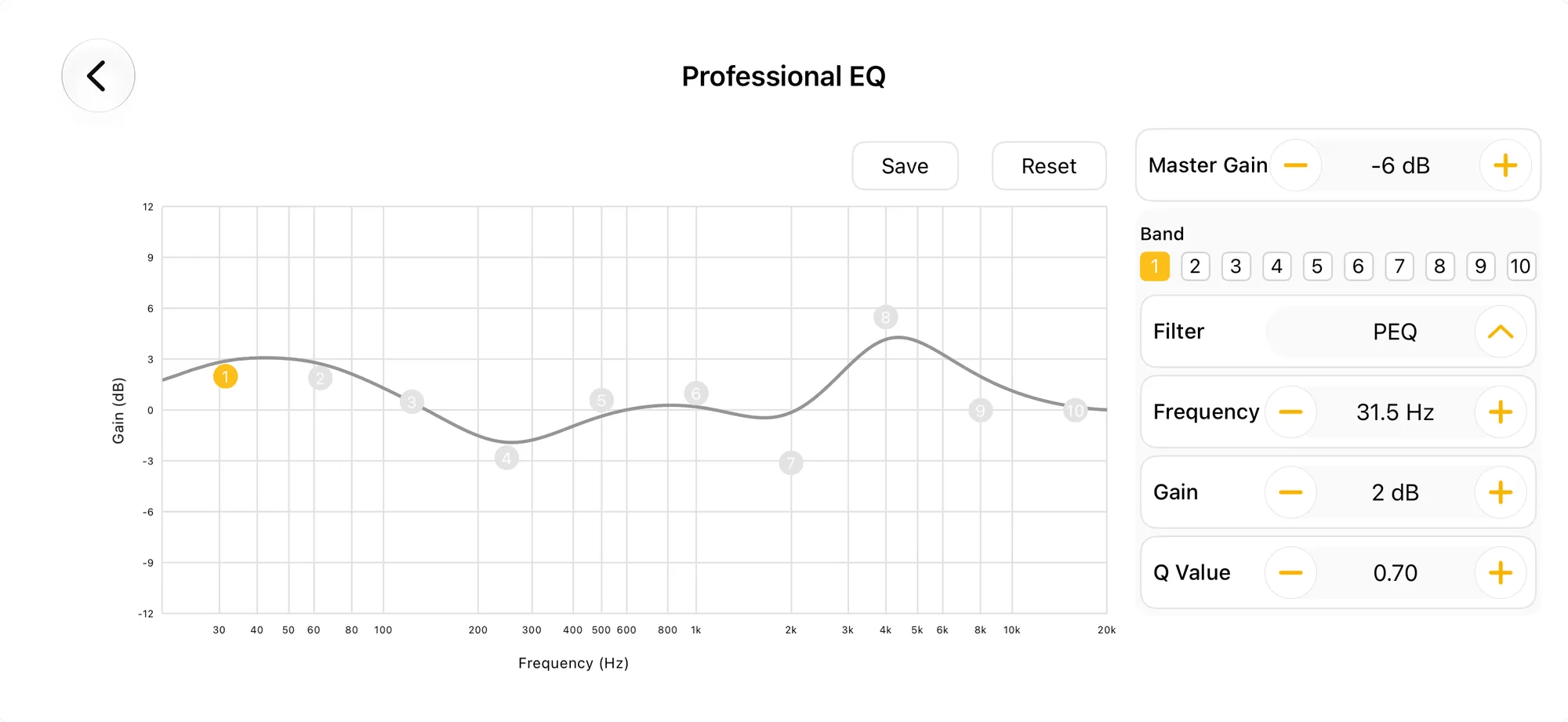
The filter type is what makes it rare. Most earbud apps give you fixed bell-shaped bands. Even the parametric ones usually stop at gain, frequency and Q. Here, each band can be a different filter: PEQ (bell), low shelf, high shelf, low-pass or high-pass. None of my other buds let me do that. It's the kind of control you normally find in desktop EQ software, not in a $100 earbud app.
Hardly anyone describes it. From research Cult of Mac and audioreviews.org use the word "parametric" in passing, with no details. Pragmatic Audio thought a parametric EQ was only rumoured, and RTINGS describes a graphic EQ. No review I found mentions the filter types or the master gain.
The catch is usability. You step every value with plus and minus buttons. It works, but it's slow.
I built my own curve. One part of it: a small lift around 4–5 kHz. From research ReganCipher measured a narrow dip near 5 kHz, which likely marks the handoff between the dynamic driver and the balanced armature. I can't prove my boost fills it, but that's why it's there.
Loudness
These buds are quiet. I listen at 70–80% on the iPhone. Of my three QCC3091 pairs, they need the most volume. Keep that in mind: louder usually sounds better, so this can make them seem duller next to louder pairs. It also costs some battery.
ANC: why I turn it off
The ANC behaves much like the Nothing Ear (2024)'s. It's average. It's strongest in the mids and upper mids.
From research RTINGS measured the same pattern: about −23 dB in the mids and treble, but only about −13 dB in the bass. SoundGuys called the ANC "about average."
But on these buds, I prefer ANC off. With ANC on, I get more of the bass I dislike, even on my own EQ or the default preset. It starts to hurt. With ANC off, the balance is closer to what I like.
From research ReganCipher measured the same effect: ANC on adds "a sizeable dollop of low-end thump" and makes the sound more V-shaped.
Wind
I didn't notice wind distortion with ANC on. There's a Wind mode, but it weakens the ANC. From research GSMArena explains why: it turns down the noise cancelling to reduce buffeting, and you have to switch it on yourself.
From research Scarbir and ReganCipher also found wind well handled, with only "a little feedback" in strong gusts. Expert Reviews disagrees: "fairly poor at cancelling wind noise, even in the dedicated mode." I'm with Scarbir and ReganCipher.
Transparency
It's an awareness mode, nothing more. You'll notice what's around you, but with music playing you can't clearly follow what people say.
There's also a catch. Sudden sharp sounds come through harsh. Drop a spoon on a porcelain floor, and you get a harsh spike in your ears.
From research Tom's Guide called transparency "a bit overstimulating," and ReganCipher heard some high-frequency hiss in it.
Calls
Usable in quiet places. In loud places, the AI processing makes my voice sound bad, and the mic catches wind easily.
From research Reviewers agree. ReganCipher called the noise reduction "a bit too aggressive," and Loud and Wireless said it "cuts into my own voice." RTINGS rated the mic 6.4. On wind, SoundGuys found the mics "struggle with simulated wind noise." Pragmatic Audio had the opposite experience: on windy days, callers didn't notice he was outside.
Battery
| My result (ANC on, AAC) | Research (test conditions differ) |
|---|---|
| 6–6.5 h | From research SoundGuys 6 h 17 min, ReganCipher 6 h 19 min (AAC), RTINGS 4.75 h (aptX, loud), Pragmatic Audio ~8 h at 50% volume |
That's below EarFun's 8-hour rating, but in line with most lab tests. From research With ANC off, ReganCipher got about 9 h.
Comfort and fit
This is a real reason to buy them. They're among the most comfortable in-ears I own. They're very light and seal like a glove on the default tips.
From research Not everyone agrees. MobileSyrup found the oval nozzle hard to keep in. RTINGS says even the smallest tips are large. If you have small ears, try them first.
App and controls
The app isn't bad. It looks good and has everything you need. It's just a little clumsy. It requires a login. Every time you open it, you have to tap Connect yourself.
The layout jumps. Take a bud out, and the buds switch from ANC to Normal on their own. In the app, the whole ANC section collapses, and everything below it jumps up. Put the bud back, and ANC turns on again, and the section expands again. I'd prefer an option to disable that.
From research I'm not alone. On the EarFun community forum, users have reported ANC switching by itself when a bud comes out since December 2025. Some said firmware 1.3.4 fixed it, others still saw it after. On 1.3.7, the switching still happens for me.
From research Most reviewers like the app a bit more than I do. Tom's Guide called the UI "clean," Expert Reviews "one of the better ones out there," and ReganCipher "logical and easy-to-read." We agree on the clutter: Cult of Mac found scrolling through "all 30 EQ presets in a single row" tedious, and Expert Reviews found the ANC modes "confusing rather than useful." None of the reviews I checked mention the login, the Connect tap or the jumping layout.
Wear detection and the case
Wear detection is hit and miss for me. Maybe my fingers cover the sensor when I take a bud out, so the music keeps playing.
The case has wireless charging and doesn't squeak. The layout is similar to the Soundpeats Air5 Pro+ case, but the Soundpeats materials feel better. This one doesn't look premium.
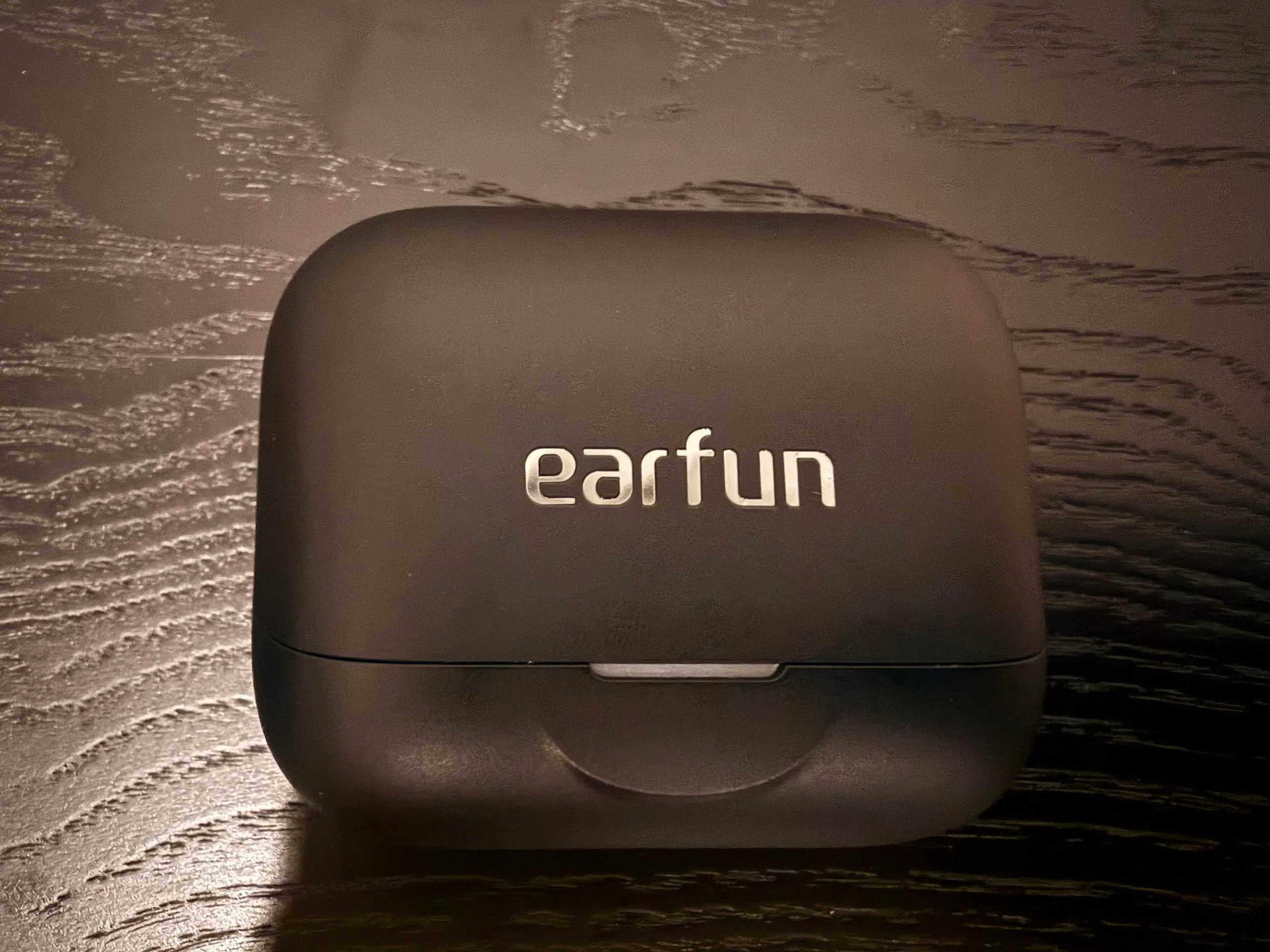
From research Tom's Guide found the lid "bent backwards easily."
Codecs and connectivity
On the iPhone you get AAC, and it sounds good. LDAC is for Android. I have had zero disconnects.
On a dongle I prefer aptX, as on all my QCC3091 pairs. Switching between aptX and LDAC in the app reboots the buds. LDAC runs with one device only.
From research RTINGS and Notebookcheck also found that LDAC disables multipoint.
One rare convenience for dongle users: the app keeps working on the iPhone while the buds play through the Questyle dongle.
The translator actually works
Another nice surprise is the voice translator. In my tests, it translates much better than the Realme Air7 Pro, where the feature felt like a total gimmick. Here it can be genuinely useful.
From research It arrived as a free update at CES 2026, with two modes: Face-to-Face and Real-Time. Reviewers split on it. Pragmatic Audio found it worked with a few seconds' delay. GSMArena found it too slow.
Where reviewers disagree with me
Most of these reviews came out in late 2025 and early 2026, on earlier firmware. I'm on 1.3.7. I can't prove firmware explains any single gap, but keep it in mind. Reviewers often split among themselves too, so for each point I say which group I'm closer to.
Sound signature. From research Reviewers are all over the place here. Pragmatic Audio calls it neutral. SoundGuys measured it close to their target. RTINGS and Scarbir call it warm. MajorHiFi calls it V-shaped, MobileSyrup bass-heavy, and audioreviews.org bright.
I hear it as steady and natural. There's plenty of bass, but it stays controlled, and the vocals are forward. I wouldn't call it warm. Still, RTINGS's numbers match what I hear: about +4 dB of bass, very accurate mids and slightly soft treble. ReganCipher's "warm and fulsome" bass on a near-Harman tuning fits too.
Does ANC change the sound? From research Pragmatic Audio and RTINGS found only small differences, and SoundGuys found none. ReganCipher measured a clear bass lift and a more V-shaped sound with ANC on. I'm firmly with ReganCipher. For me, it's the reason I listen with ANC off. Seal may matter: a tighter seal makes ANC's bass lift easier to hear.
Stage. From research Tom's Guide heard vocals coming "from all around," and Expert Reviews and Pragmatic Audio praised the imaging. MajorHiFi called it "very closed-in," and ReganCipher said it "isn't the widest." I'm with the second group. On a live recording, the people end up inside my head.
Cymbals. From research RTINGS called the cymbals "a touch soft." I partly agree: they don't carry much weight. But they're not thin, and the resolution is good. ReganCipher heard slightly "splashy" hi-hats, and audioreviews.org called them "tizzy." I don't hear either. On "Take Five," the last cymbal hit keeps a long, natural tail. I'm closer to Pragmatic Audio, who found the treble "airy and fatigue-free," with a nod to RTINGS on weight.
ANC strength. From research Loud and Wireless found the ANC "very good in the low frequencies." RTINGS measured the bass as the weakest range. My experience matches RTINGS: strongest in the mids, average overall, much like the Nothing Ear (2024).
Comfort. From research MobileSyrup couldn't keep them in, and RTINGS found the tips large. For me, they're among the most comfortable pairs I own. Fit is personal, so try them on if you can.
The translator. From research GSMArena found it too slow to be practical, and GamingTrend found the translation plays from the phone speaker. In my tests, it worked well enough to be useful.
Verdict
So, a singer's earbud on a budget? Yes, and that's both its strength and its limit.
The EarFun Air Pro 4+ scores 7/10 for sound and 7/10 overall. Voices are forward and detailed. Cymbals have good resolution and a natural tail, if not much weight. Everything else is steady and naturally good. But the stage is narrow, and the bass punches without blooming. ANC on makes the bass worse for me, so I listen with it off.
Around the sound, you get real comfort, a hidden Professional EQ that's among the most capable I've seen, a translator that actually works, and zero disconnects. ANC is average, transparency is only an awareness mode, and calls struggle in noise. The app is a little clumsy, but not bad.
At about $75 on sale, it's good value for the right listener. For my own listening, I prefer the A100, and I think the price difference is justified.
Buy it if:
- You listen mostly to vocals and want them forward and detailed.
- You wear buds for hours. Comfort is one of its best points.
- You like to tune. The Professional EQ rewards you.
- You travel and want a translator that's actually useful.
Skip it if:
- You want bass with bloom and excitement, especially for EDM.
- You want a wide stage. Here, the room ends up inside your head.
- You need strong ANC, or you rely on transparency to talk.
- You make a lot of calls in noisy places.
Take care, everyone. If you've read this far, I hope it helped. :)