Why this pair
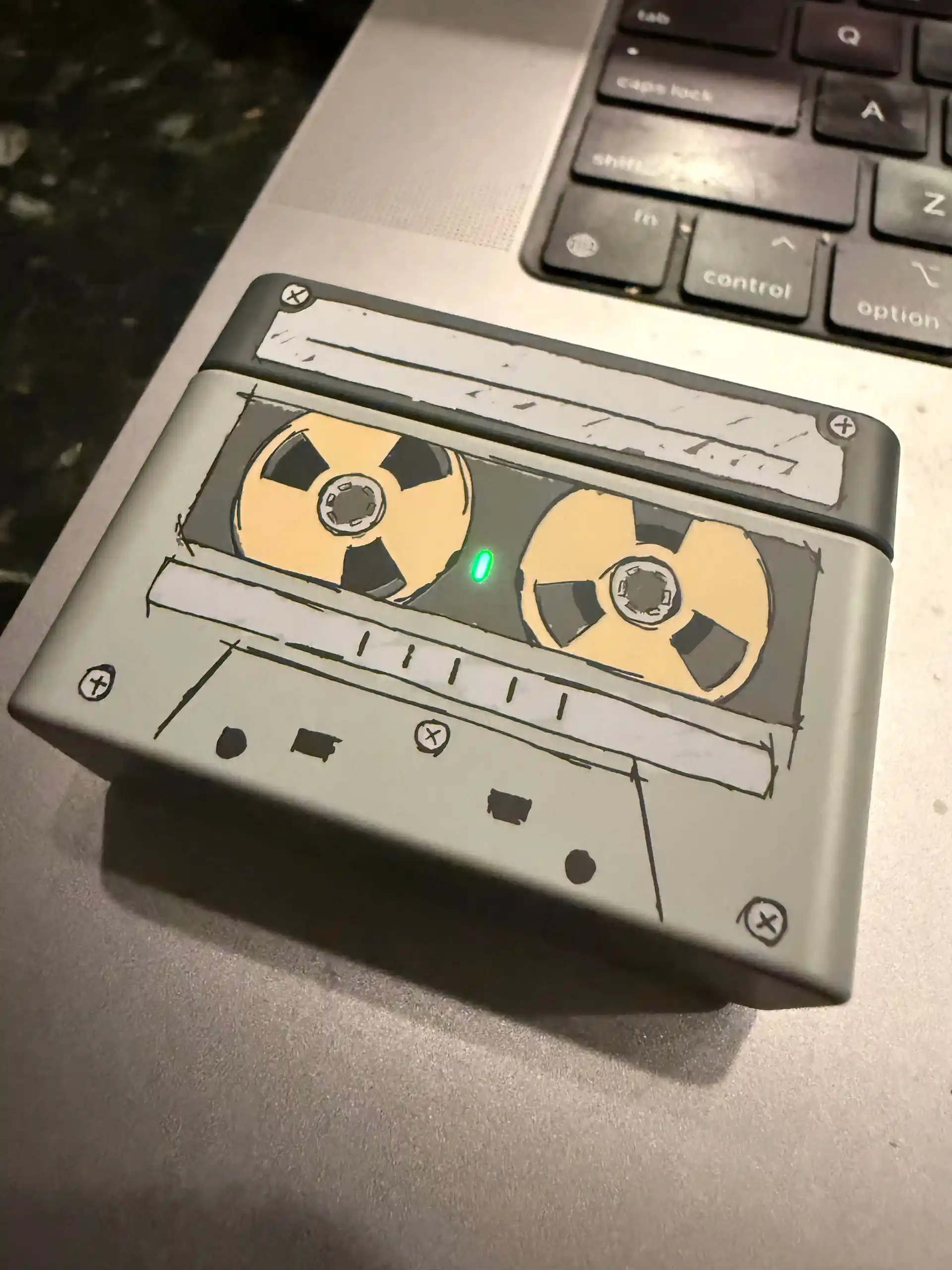
The Golden Ages 2 launched in September 2025 at $89.99. Today it sells for about $72–76. It's Moondrop's flagship true wireless pair, and one of the few with a planar magnetic driver.
So here's the question: can a $90 planar pair deliver a clean, neutral sound without the usual true wireless compromises?
These are two-week impressions, not a long-term review. For those two weeks it was the only pair I used.
One more thing up front. I make Arclet, an app that controls earbuds, and it supports this pair. Some findings below come from that work. I say so each time.
What's inside
From research Moondrop is open about the driver and vague about the chip. One teardown, by 52audio, fills in most of the rest.
| Spec | Moondrop Golden Ages 2 |
|---|---|
| Driver | 13 mm annular planar magnetic, N55 magnets |
| Chip | Marked "MOONDROP TYPE-TW01", 22 nm |
| Bluetooth | 6.0, multipoint |
| Codecs | SBC, AAC, LDAC, LHDC 5.0, LC3 |
| ANC | Feed-forward only, two microphones per bud |
| Weight | 5.1 g per bud, 42 g case |
| Battery (rated) | About 8 h over AAC, 24 h more from the case |
| Cells | 40 mAh per bud, 400 mAh case |
| Protection | No water rating |
| Charging | USB-C and wireless |
| Price | $89.99 at launch, about $72–76 now |
Three things are worth knowing
- The planar driver runs straight from the chip. Planar drivers usually need more power than dynamic ones. That's hard with a 40 mAh cell. From research Moondrop says its ring-shaped diaphragm and magnets make the driver efficient enough. The teardown agrees on the result: it found no separate amplifier. Nobody has verified the efficiency figures themselves, so I treat them as claims.
- The ANC has no microphone inside the ear. Most pairs at this price use a hybrid design, with one microphone outside and one in the ear canal. Moondrop dropped the inner one on purpose. Its stated reason: the sound shouldn't change when you switch noise cancelling on or off. The teardown confirms both microphones face outward. This one choice explains a lot of what follows.
- The chip is probably from Bluetrum. The chip carries Moondrop's own marking. But the board in the FCC photos is printed
039_8952F, which points to Bluetrum's BT8952F family. That's my reading of the photos, not something Moondrop says.
How I tested
- About two weeks of daily use as my only pair. Not a long-term review.
- The largest stock tips.
- iPhone over AAC every day. Questyle dongle over LDAC now and then.
- Mostly the Reference preset. Sometimes one of two custom curves I fitted in Arclet: JM-1 Harman and Neutral (5128).
- Middle gain most of the time, high gain from time to time.
- Firmware 1.2.0.
- Settings changed in Arclet, my own app, not in Moondrop's.
- I checked my impressions against published reviews. Where reviewers disagree with me, I say so. Anything I haven't tested myself is marked From research.
Clean, neutral, high resolution
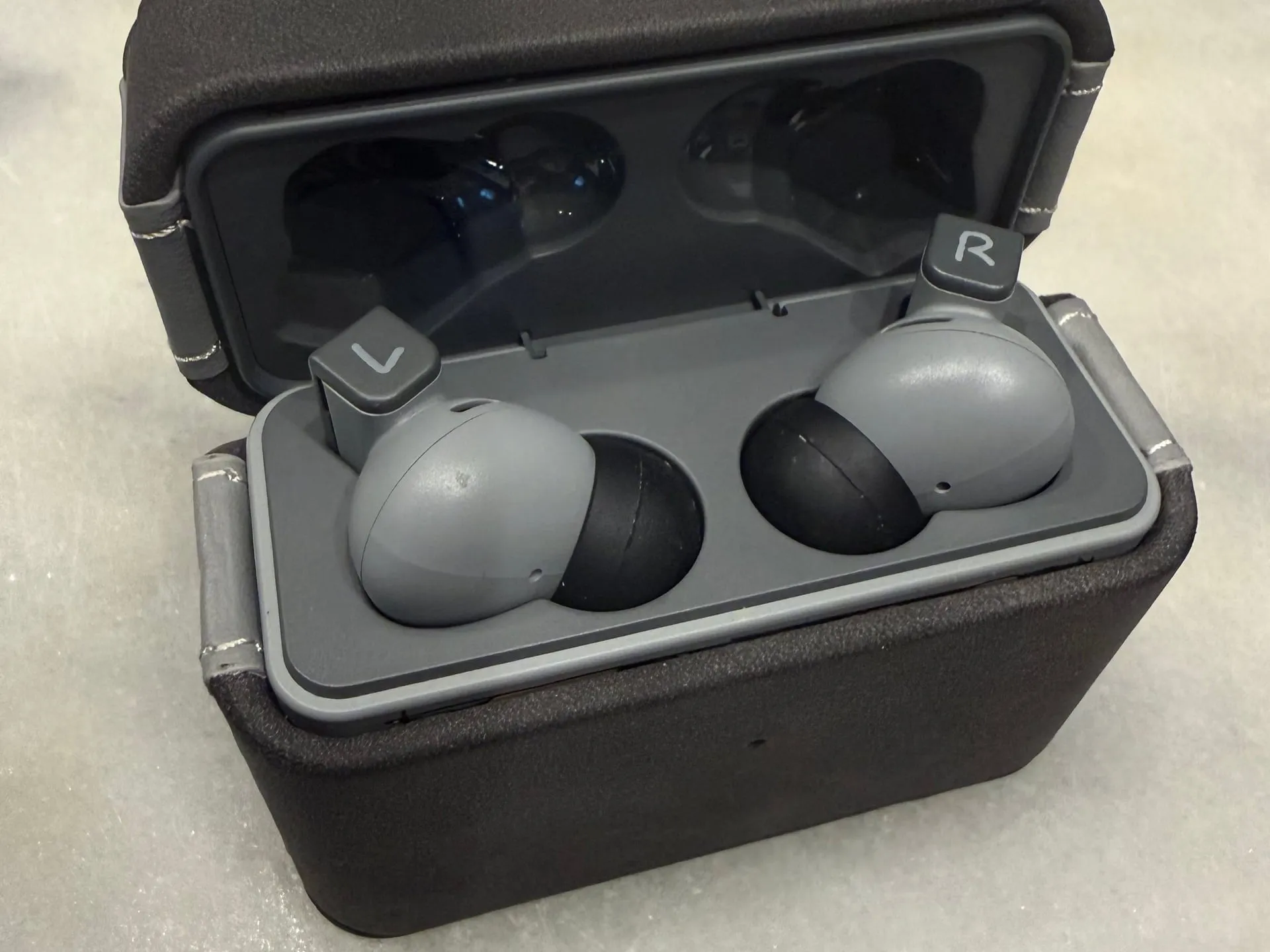
This is why you buy the Golden Ages 2. The sound is very clean and quite neutral. The resolution is high. Nothing is pushed at you.
For my taste it's a 9.5 out of 10. For instrumental music and rock, it's a perfect fit. For R&B and EDM, it depends on how much low end you want. There I'd put it around 7.5.
Reviewers mostly agree on the strengths. From research Kenneth Tanaka gives the sound 10 out of 10. Gamesky calls it the most detailed true wireless pair Moondrop makes. ReganCipher found it the most natural of the three pairs he compared.
Bass: control without bloom
This is the most repeated complaint in reviews. From research Gizaudio calls the pair bass-light. Jessy Audio Review calls the impact very weak. Your Glory Days calls the bass super weak.
I hear it differently. This is for sure not a basshead pair. But I wouldn't say it lacks bass. What it lacks is bloom, and that's not the same thing. The notes are there, tight and controlled. They just don't swell after the hit.
The EarFun Air Pro 4+ also has controlled bass. But that one tires me, and this one doesn't. The Golden Ages 2 keeps its control without any harshness.
In the end, it's a matter of preference. If you want bloom, you won't find it here.
Vocals and mids
High resolution and plenty of detail. On the default tuning, I hear no sibilance.
From research Two reviewers hear a lift around 3 kHz. Vortex Reviews finds it makes the sound a little unnatural. WhatsNew hears voices as slightly husky at times. I don't have that problem.
Treble
By default, this pair is on the bright side. I agree with reviewers on that. But I hear no harshness, and it stays comfortable through long sessions.
From research iXBT measured a peak near 6 kHz in every preset. They found it harsh and tiring on bright recordings. ian fann heard the opposite, a polite and safe treble. I sit between them: bright, not harsh.
Soundstage
Wide for true wireless. It's easy to check. Try Yosi Horikawa's "Bubbles" or Amber Rubarth's "Strive."
From research Reviewers split here. Gamesky and Jessy Audio Review call the stage wide. Sean Talks Tech and Vortex Reviews put it in the middle. Izzy Laif hears a narrow corridor. I'm with the first group.
Presets: what they really do
The app shows three presets: Pop, Reference and Monitor. Reviewers describe them in opposite ways. From research Gizaudio hears Reference as fuller with less sparkle. iXBT calls Reference the most V-shaped. UtmostCoin Reviews says Pop is the V-shaped one.
Here's what I found while adding this pair to Arclet.
Pop is the buds' own sound. A flat custom curve sounds the same as Pop to me. Reference and Monitor are EQ on top of it.
Next to Pop, Reference and Monitor both sound a little quieter and brighter to me.
The measured reviews point the same way. From research iXBT found that Reference deepens the dip between 150 and 300 Hz and adds treble. Kenneth Tanaka found that Monitor flattens the bass and sounds a bit too bright.
So Reference keeps the deep bass, trims the area where bloom lives and adds treble. Monitor is the same idea with the deep bass taken out. That matches what I hear on Reference, my favorite: clean, a little bright, no bloom.
Two hidden presets My finding
This is my own finding. None of the reviews I checked mention it.
The buds carry five factory presets, not three. Moondrop's app shows Pop, Reference and Monitor. Two more sit in the firmware, and Arclet shows them.
To my ears, the first is more neutral, with tighter bass and a forward voice. The second is louder and warmer. It sounds more spacious, but its bass is looser.
Arclet labels them 89xx and 336xx. Those names are inferred from another Moondrop model, the Ultrasonic. It comes with five presets: Monitor, Reference, Club, 89xx and 336xx. The last two are likely the ones hidden on these buds. Moondrop doesn't name them on this pair.
My two custom curves
Besides Reference, I use two curves I fitted in Arclet.
- JM-1 Harman adds bass.
- Neutral (5128) is the flattest of the three and less bright.
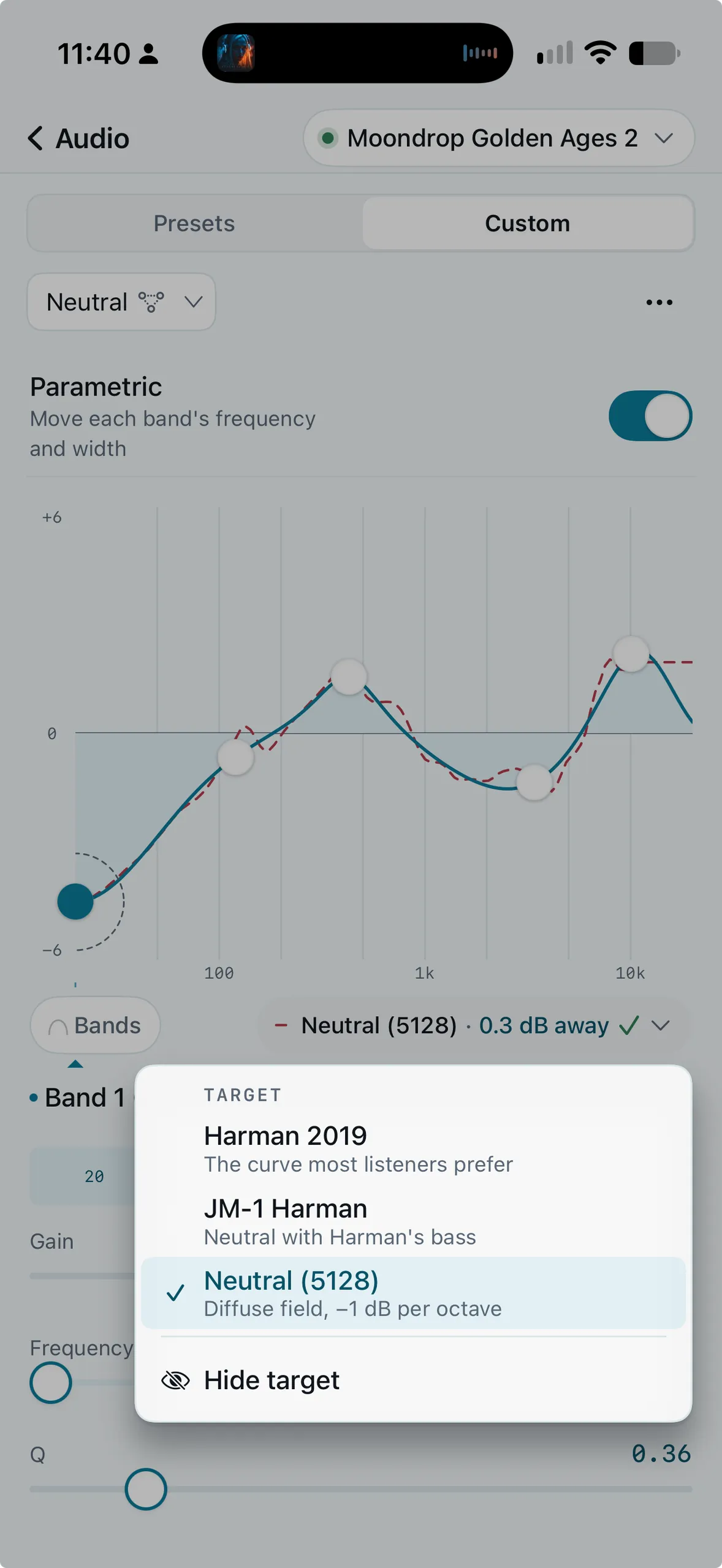
The buds have a five-band parametric EQ. You set the frequency, gain and width of each band.
One limit is worth knowing. Moondrop's app lets you boost a band by 3 dB at most. The buds themselves store up to 12 dB each way. I checked that in 3 dB steps.
ANC
The ANC is truly average. It won't compete with stronger pairs.
From research Three measurements agree. iXBT got 25.8 dB on average from 50 Hz to 1 kHz. The Sony WF-1000XM6 got 37.1 dB on the same test. Jessy Audio Review measured 24 dB on average. WhatsNew measured about 20–22 dB.
But it has two advantages over more powerful buds.
First, you don't notice it in your ears. There's no pressure, so it's easy to wear.
Second, it doesn't change the sound. That matters if you want a consistent listening experience. From research iXBT measured nearly identical curves with ANC on and off. The two published measurements I traced for Arclet agree within 0.1 dB.
This is the missing inner microphone at work. The design costs strength and buys consistency.
Wind
I didn't notice wind artefacts while listening. I haven't heard a recording of my own microphone in wind, so I can't speak for calls.
From research The buds have a Wind mode, and reviewers split on it. Gizaudio says it really cuts wind noise. iXBT found no clear benefit and weaker noise cancelling. Jessy Audio Review calls the effect barely noticeable.
Transparency
Moondrop took its own approach here. Transparency truly boosts voices. I can see why some people dislike that. For me, it's something other earbuds lack.
It also treats sharp sounds well. Say you drop a spoon on a porcelain floor. With the Soundcore Liberty 5 Pro, that's painful on the ears. With the Golden Ages 2, it sounds like a spoon hitting the floor.
From research Gamesky, Sean Talks Tech, Kenneth Tanaka and ReganCipher find the mode natural. WhatsNew says it isn't transparent and amplifies voices. Jessy Audio Review found it very hard to use.
A sporadic hiss My finding
This is my own finding. None of the reviews I checked mention it.
Sometimes I catch a faint hiss. It feels a bit like the buds are picking up a radio. :) It's sporadic and nothing very annoying.
Calls
The microphone is usable. That's the most important thing.
It cuts noise, but not completely, and not in an aggressive way. Too many competitors cut too hard these days. In harsh conditions they chew up your own voice. This one doesn't.
The mic isn't perfect. Still, I'm fine taking calls with it.
From research ReganCipher found it the cleanest voice of his three pairs. iXBT hears a telephone tint. UtmostCoin Reviews calls it robotic.
Battery
| My result (AAC) | Research (test conditions differ) |
|---|---|
| 6–7 h, depending on gain and volume | From research iXBT got 7 h 32 min over AAC with ANC on. Over LDAC, they got 3 h 02 min. |
With AAC, you can count on 6–7 hours without thinking about the setup.
Hi-res codecs are another story. From research Kenneth Tanaka says each feature costs about an hour. With ANC, LDAC and spatial audio together, he got about 4 hours.
Comfort and fit
Comfortable, including long sessions. I use the largest stock tips. I also tried Divinus Velvet tips in size L and went back to the originals. They're comfy.
The Divinus test showed one useful thing. Oversized third-party tips still fit in the case.
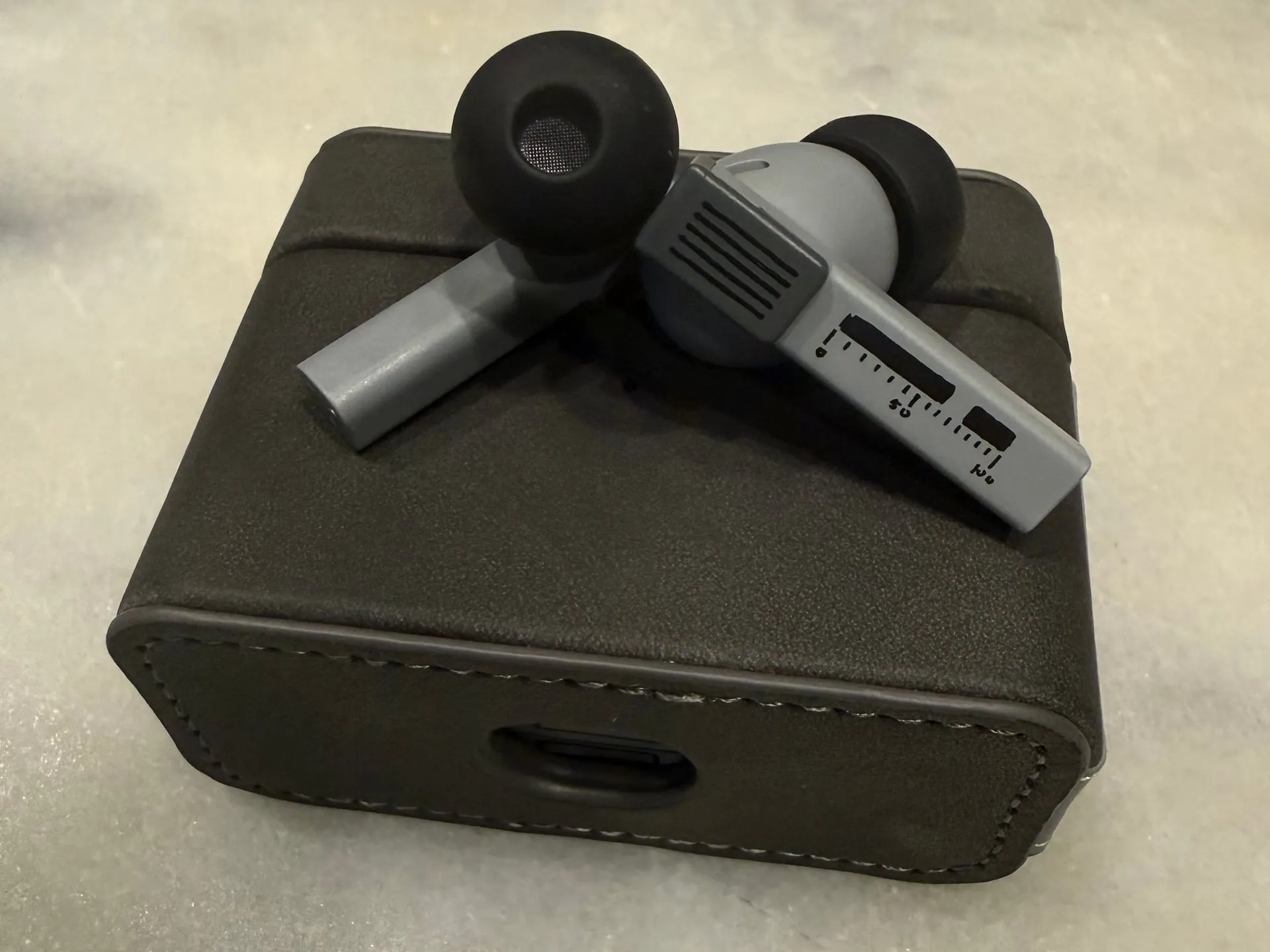
I like the classic, well-recognized shape. The buds are compact and easy to wear. The squarish stems are convenient for adjusting.
Controls and wear detection
I like the raised pads. They're easy to hit. From research You can remap five gestures per bud, including volume.
There's no wear detection. Music doesn't pause when you take a bud out. It would be useful, and I don't see why Moondrop left it out of its flagship. Its Moca buds had optical sensors.
Codecs: LDAC and EQ
On my unit, LDAC through the Questyle dongle is stable.
EQ works under LDAC on firmware 1.2.0. I checked in both Moondrop's app and Arclet. Launch reviews said it didn't, so this has been fixed.
Some things I haven't tested. From research iXBT had LDAC dropouts at maximum quality and found LHDC more stable. Multipoint works only over SBC and AAC. On Head-Fi, one owner couldn't get LE Audio to sound right: the buds showed up as a separate device and sounded flat.
A codec change restarts the buds. That's normal for this pair.
Spatial audio
It works. I didn't test beyond that, because I dislike spatial audio.
Connection and daily quirks
In general, a quite stable experience. But it could be smoother.
- Sometimes the buds lose the connection and don't wake up when I open the case. I have to put them back in first.
- On occasion, one bud doesn't charge. That's annoying. Placing the buds in the case again usually fixes it.
- The case doesn't report its charge level. I find that inconvenient.
- Sometimes the app reads stale data.
The app
I use Arclet, my own app, so I avoid Moondrop's app almost entirely. I can't rate it fairly, and I don't.
From research It's the most repeated complaint about this pair. Jessy Audio Review calls it extremely laggy. ReganCipher found it improved but still clunky, with the online EQ library down for a whole day. On Head-Fi, one early owner couldn't find where to log in or where to switch on LDAC. Kenneth Tanaka disagrees. He calls it by far the best parametric EQ implementation.
You still need Moondrop's app for firmware updates. Arclet never touches firmware.
Case
The case charges wirelessly. I can confirm it. From research Two reviewers say it doesn't, and Moondrop's spec table doesn't mention it. The teardown found the charging coil.
The weaknesses:
- It's too big. I wish it were smaller.
- The lid could be better.
- It can be difficult to put the buds back in, especially in the dark. I'd like to see that addressed.
Where reviewers disagree with me
- Bass. Same facts, different words. From research Gizaudio, Jessy Audio Review and Your Glory Days call it light or weak. I hear enough bass and no bloom. Kenneth Tanaka is closer to me: he says the bass is no slouch for a planar.
- Treble. iXBT finds the 6 kHz peak harsh and tiring. ian fann finds the treble polite. I hear a bright pair with no harshness, comfortable for long sessions.
- ANC. AndyAudioVault calls it excellent. Gamesky says it kind of sucks. The measurements and I land in the middle: truly average.
- ANC pressure. Jessy Audio Review reports noticeable ear pressure. iXBT and Kenneth Tanaka report none. I feel none.
- Transparency. WhatsNew and Jessy Audio Review dislike the voice boost. I like it, and so do most reviewers.
- Calls. From the cleanest of three (ReganCipher) to robotic (UtmostCoin Reviews). For me it's usable, because it doesn't over-process my voice.
- Comfort. iXBT wanted them out after about two hours. ian fann found the seal fiddly. I wear them for long sessions on the stock tips.
- Soundstage. Izzy Laif hears a corridor. I hear a wide stage for true wireless.
- Wireless charging. UtmostCoin Reviews says there's none. My case charges wirelessly.
- EQ under LDAC. Launch reviews from Gizaudio and Gamesky said it wasn't available. On firmware 1.2.0, it works.
Verdict
So, a golden age for neutral sound? For the sound itself, yes.
The Golden Ages 2 is good+ buds. You get a very clean, quite neutral sound with high resolution and a wide stage. The bass is controlled and never harsh. The ANC is average, but it stays out of your ears and out of the music. Transparency and calls take a gentler approach than most.
The rest holds it at 8 out of 10. The case is big and fiddly. There's no wear detection. Daily use has a few rough edges.
Some people should skip it:
- Bass lovers who want bloom and slam. The bass is there, but it doesn't bloom.
- Anyone who needs strong ANC. This one is average by design.
- Anyone who wants a small, pocketable case. This one is big.
- Anyone who relies on wear detection. Music keeps playing when you take a bud out.
If none of those is a dealbreaker, and you listen to instrumental music or rock, this is a perfect fit.
Take care, everyone. If you've read this far, I hope it helped. :)